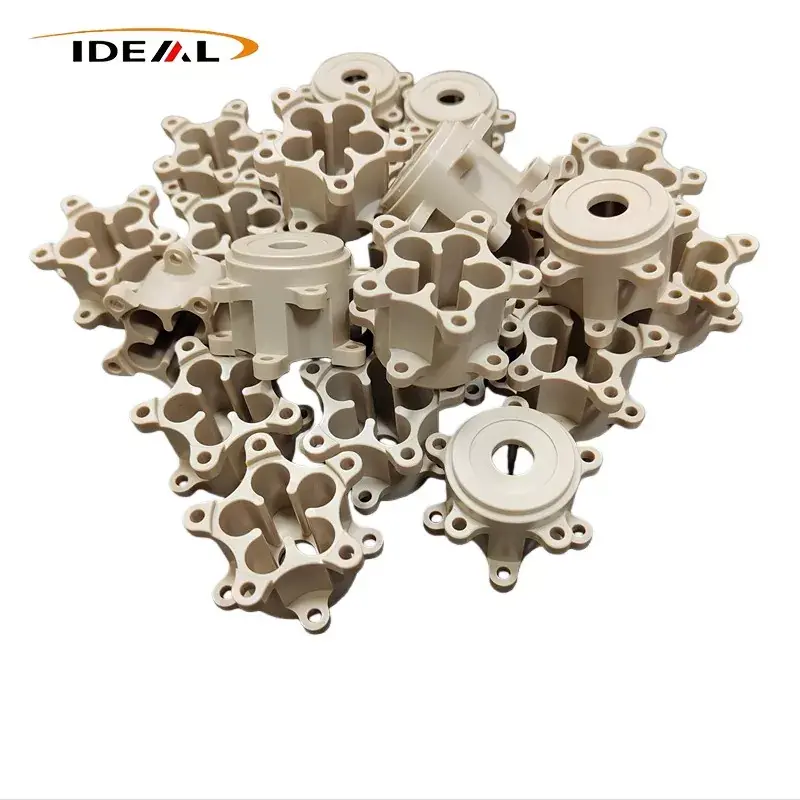
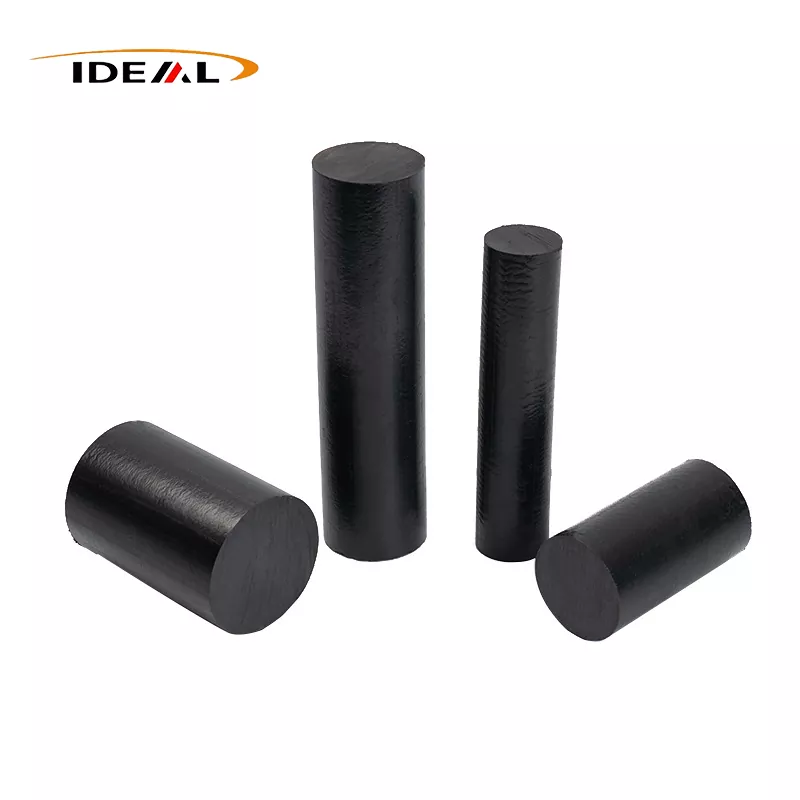
Here at GuangZhou Ideal, we use professional CNC machines to produce CNC PEEK part. The PEEK material we work with is a special engineering plastic with some really standout properties. If you break it down to the molecular level, its structure is basically a repeating pattern of "benzene ring – ketone bond – benzene ring – ether bond – benzene ring – ether bond." That setup is pretty clever—the rigid benzene rings act like "steel bars," giving the material its strength and heat resistance. Meanwhile, the flexible ether and ketone bonds work like "springs," allowing the chains to move just enough so the material stays workable and tough under impact.
When machining CNC PEEK part, using the right cutting tools makes all the difference in the final quality. We’ve picked up some practical tips along the way—here’s what we recommend:
What kind of tool material should you use?
We always go with carbide tools first. They’re hard, wear-resistant, and can take the heat—which is important because PEEK tends to get hot during machining. Carbide keeps things accurate and avoids broken edges.
Does the tool shape matter?
Absolutely. A smaller rake angle—somewhere between 10° and 20°—works best. It cuts more smoothly and leaves a nicer finish. If the angle is too large, you actually lose cutting efficiency, so it’s not a case of “bigger is better.” Match the angle to the material—don’t overdo it.
What about tool size?
That depends on the job. Smaller tools are great for detail work like drilling tiny holes, tidying up edges, or fine surface finishing. They just handle better for precision tasks.
Oh, and one more thing—the tools you use for roughing and finishing should be different. Roughing calls for something tough and aggressive, while finishing needs a tool that prioritizes smoothness, accuracy, and consistency.
Don’t forget tool maintenance
Tools don’t last forever. With use, they wear down, so make sure you check them regularly—how sharp they are, whether they’re still the right shape. Don’t wait till they’re completely dull before replacing or resharpening. A worn-out tool can easily mess up your workpiece.
As a CNC PEEK product machining supplier based in China, GuangZhou Ideal has built up our own tech team and specialized equipment over the years—and we’ve learned a lot along the way. Whatever your machining challenge is, we’re here to help you figure it out.
|
Product name |
PEEK CNC parts |
|
Material |
Pure PEEK, carbon fiber reinforced PEEK, glass fiber reinforced PEEK, bearing grade PEEK |
|
Color |
Nature,black and custom color |
|
Size |
ODM/OEM/Drawing |
|
Tolerance |
According to customer requirements |
|
Forming method |
according to product shape and order quantity |
|
Minimum order quantity |
negotiation |
|
Lead time |
10-15 days |


1. It can seriously take the heat.
CNC PEEK part doesn’t even start to soften until 143°C, and it melts way up at 334°C. Even under pressure, it holds its shape up to about 316°C. You can use it non-stop at 250–260°C, no problem. Short bursts at 300°C? It can handle that too. And even under high heat and pressure over time, it doesn’t give up—its performance stays strong.
2. It’s stiff and won’t bend out of shape.
Thanks to its tightly packed molecular structure (full of aromatic rings), this stuff is seriously rigid. It’s hard to bend or deform. Its heat deflection temperature is up to 315°C, and even at 200°C, it keeps more than 70% of its strength—so no collapsing or loosening.
3. Acids and alkalis? No big deal.
CNC PEEK product has a dense molecular structure with super stable chemical bonds, so it’s really corrosion-resistant. Whether it’s common acids, strong bases, salt solutions, or organic solvents—soaking in them long-term changes its weight by less than 1%. Its look and strength pretty much stay the same.
4. It holds up against radiation.
After long-term exposure to radiation, the surface might get a bit harder or brittle, but its overall mechanical performance usually doesn’t take a hit. That means it can hang in there for a good while even in radioactive environments.
5. Steam and water won’t break it—great for medical sterilization.
PEEK CNC parts works reliably long-term even at 260°C, and it’s totally fine with high-temperature steam. That’s why it’s a favorite in medical devices—it can go through repeated steam sterilizations without losing its strength or function.
6. Top-notch insulator.
Its volume resistivity is between 10¹⁶ and 10¹⁸ Ω·cm, dielectric constant (at 1 MHz) is around 3.2–3.3, and it has really low dielectric loss—below 0.002. Even under high-frequency or high-voltage conditions, like in electronics or high-voltage insulation, it stays reliably insulating.
1.PEEK is seriously such a handy material for all kinds of machinery. It’s got this self-lubricating thing going on, can handle crazy high temperatures, and doesn’t warp easily. That’s why you’ll often see it used in wear-resistant parts, high-temperature components, and all sorts of precision mechanical pieces.
2.When it comes to lab equipment, CNC PEEK part is also a total win. It’s super gentle on biological tissues, doesn’t corrode easily, and the precision is top-notch. That makes it perfect for things like bio-experiment tools, lab consumables, and all kinds of sensitive instruments.
3.Over in the food industry, PEEK has really found its place. Because it stands up to heat and harsh chemicals, you’ll spot it in food processing gear—think conveyor belts, mechanical parts, seals, and more.
4.Then there’s the semiconductor world. They’ve caught on to PEEK’s killer insulation and low dielectric loss, so it’s often the go-to for high-frequency connectors and electronic packaging—works like a charm.
5.In the AI and robotics scene, CNC PEEK product is getting more and more love. If you use it to make joint frames, gears, or bearings, the parts can be up to 40% lighter than metal ones—but just as tough. We’re talking tensile strength hitting 200MPa. That means robots can move more smoothly and actually carry more stuff.
6.And let’s not forget aerospace. PEEK has become a dream material for aircraft engine parts because it handles heat, resists radiation, and is flame-retardant. You’ll often find it in critical spots in rocket engines, too.
Over the years, we at GuangZhou Ideal have been working hard to improve our CNC milling machines, lathes, and machining centers—making sure they’re more precise and reliable with every upgrade. We know how important accuracy and quality are to you, so we take care of every little detail in our CNC PEEK part product line, from design and manufacturing all the way to testing. Quality is something we never cut corners on.
And it doesn’t stop there—we’re here for you before, during, and after your purchase. Got a project in mind? Or maybe a question? Just reach out. We’ll get back to you quickly with answers that make sense, so you can move forward with confidence.
1.So, about the performance of our products—are they reliable?
Absolutely! We use raw materials from well-known brands, both local and international. Every batch comes with a test report, and their performance is among the best in the industry. If you’d like, we can send you a detailed performance sheet anytime.
2.And is the product quality guaranteed?
Yes, definitely. We have a full quality control system in place. From the moment materials arrive until the product is shipped out, there are professionals and advanced testing equipment at every step. That way, we make sure every item you receive is solid and dependable.
3.Can we customize products based on our needs?
Of course! We accept common 2D/3D file formats like STEP, STP, STL, IGS, and PRT. If you have a physical sample, just send it over—we can analyze it and work from there. We can also design or tweak the product based on your ideas.
4.What’s the minimum order quantity?
For semi-finished profiles, we accept orders for even one piece. If it's custom parts, the minimum order depends on the processing method and size—we’re flexible and can work something out.
5.How long does delivery usually take?
For standard products like profiles that are in stock, we ship right after payment. For custom orders, we’ll confirm the timeline with you based on the quantity and processing requirements.
6.What logistics options do you offer?
We usually work with mainstream carriers like DHL and FedEx, by air or sea—it's fast and convenient. If you have your own freight forwarder or logistics partner, that’s fine too—we’re happy to coordinate. Shipping costs are handled by the customer and will be calculated based on the product’s size, weight, and destination.