You have an assembly drawing with a wide bore, a heavy wall, and little room for machining error. The next question is obvious: can a PEEK pipe manufacturer produce the required blank, or will the geometry create tooling, distortion, or material problems?
Large-diameter PEEK pipe can be made, but the drawing must be reviewed as a complete profile. Diameter is only one variable. Wall thickness, length, grade, quantity, tolerances, machining allowance, and the required finished condition can change the practical production route.
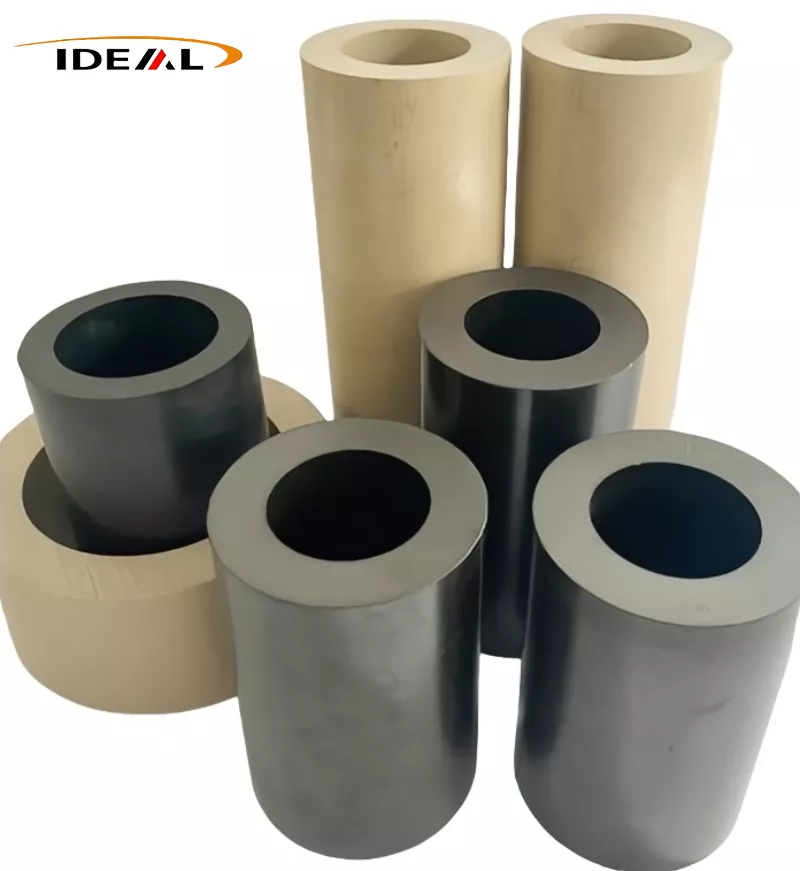
The useful answer is yes, subject to engineering review. A large outside diameter with a generous wall and machining allowance may be more practical than a smaller profile with a thin, tightly controlled wall. Long parts can also be harder to keep straight and concentric than shorter blanks of the same diameter.
Hollow PEEK profiles must retain their shape while the material is formed and cooled. Uneven wall geometry can contribute to differential shrinkage, ovality, bow, or variation between the outside diameter and bore. Tight tolerances reduce the process window further, especially if every surface is expected to arrive at final size without machining.
GuangZhou Ideal supplies PEEK pipe profiles and custom tube stock using extrusion for regular profiles and compression molding for larger custom profiles. That distinction is a starting point, not an automatic diameter cutoff.
Do not select a process from outside diameter alone. The supplier needs to know whether you want an as-produced tube, a semi-finished blank for later machining, or a finished component. Tooling cost, order volume, dimensional repeatability, and material yield all affect the choice.
Extrusion is suited to regular, continuous profiles. It is often the logical route for established tooling, repeat demand, and lengths that can be cut from an extruded run. The die and downstream controls must support the requested OD, ID, wall, straightness, and concentricity.
Extrusion should not be assumed to deliver every surface at finished-machined tolerance. If the bore, outside diameter, or sealing land is critical, ask whether the quoted dimensions are as-extruded or include machining. Also confirm the minimum production quantity; a technically possible extrusion may make little commercial sense for a one-off blank requiring new tooling.
Compression molding may be considered when the requested custom profile is larger or does not fit an established extrusion route. It can provide a near-net or semi-finished blank from which critical surfaces are machined.
The trade-offs are tooling, cycle requirements, material usage, and the amount of finishing needed. Thick sections and uneven geometry require careful review because cooling behavior can affect internal stress and dimensional stability. Ask where material will be left for cleanup and how the blank should be supported during machining. “Molded to size” and “ready to install” are not interchangeable specifications.
PEEK pipe and PEEK tube are often used as search terms for the same hollow semi-finished profile. On a purchase order, however, those words are not enough. “Pipe” may be interpreted as a nominal piping product, while “tube” is commonly defined by actual OD, ID, and wall.
Your drawing should identify:
Show dimensions in both inches and millimeters for U.S. procurement, but identify one unit system as controlling. Converted reference dimensions should not create false decimal precision. GuangZhou Ideal’s site references 1,000 mm and 3,000 mm lengths and a claimed ±0.02 mm tolerance; applicability to a particular diameter, feature, process, and grade must be confirmed on the quotation and approved drawing.
Grade selection should follow service conditions, not a preference for the highest filler percentage. Temperature, chemicals, load direction, wear, electrical requirements, mating materials, sterilization or cleaning cycles, and applicable regulatory controls can all change the decision.
| Grade listed by GuangZhou Ideal | Why a buyer may consider it | What must be verified |
|---|---|---|
| Unfilled PEEK | A general-purpose starting point when a filled grade is not required | Extrusion or molding route, service compatibility, dimensions, and machining allowance |
| Glass-fiber-filled PEEK | Considered where added stiffness or dimensional control is part of the design objective | Fiber orientation, surface condition, machining behavior, and suitability for mating parts |
| Carbon-fiber-filled PEEK | Considered for stiffness, wear, or thermal-management objectives | Directional properties, electrical behavior, tool wear, surface finish, and process availability |
| Abrasion-resistant or bearing grade | Intended for sliding or wear-related applications | Exact formulation, counterface, lubrication, speed, load, temperature, and supporting test data |
This matrix does not assign every grade to every production method. Filled compounds can flow, shrink, machine, and finish differently from unfilled material. The manufacturer must confirm that the selected grade, tooling, wall geometry, and process are compatible. For bearing service, test data from a relevant duty cycle is more useful than a generic “wear-resistant” label.
Confirm stock status against the exact grade and dimensions. GuangZhou Ideal states that standard sizes may be available from stock, while custom profiles have production lead times. Samples may also be available. Review the current PEEK pipe stock and custom-size information rather than assuming that a listed category means your bore, wall, or length is on the shelf.
Just as important, determine the product’s legal and engineering role. Semi-finished machinable PEEK tube stock is not automatically a qualified pressure pipe. A pressure-bearing installation may require design-code compliance, pressure testing, joint qualification, inspection, and application-specific approval that a material certificate alone does not establish.
Send a dimensioned drawing rather than a description such as “large PEEK tube.” Mark the controlling units, final dimensions, blank dimensions, critical tolerances, datums, surface-finish requirements, and inspection method. Include expected order quantity and repeat demand so the production route can be assessed commercially as well as technically.
If ISO, REACH, or RoHS documentation is required, identify the exact document, revision, material grade, and lot relationship you expect. Do not assume that a general company document satisfies a part-specific purchasing requirement.
For a useful feasibility review, submit those details through GuangZhou Ideal’s large-diameter PEEK pipe page and ask the quotation to state the proposed process, tooling requirement, supplied condition, achievable dimensions, machining allowance, inspection scope, lead time, and documentation package.