



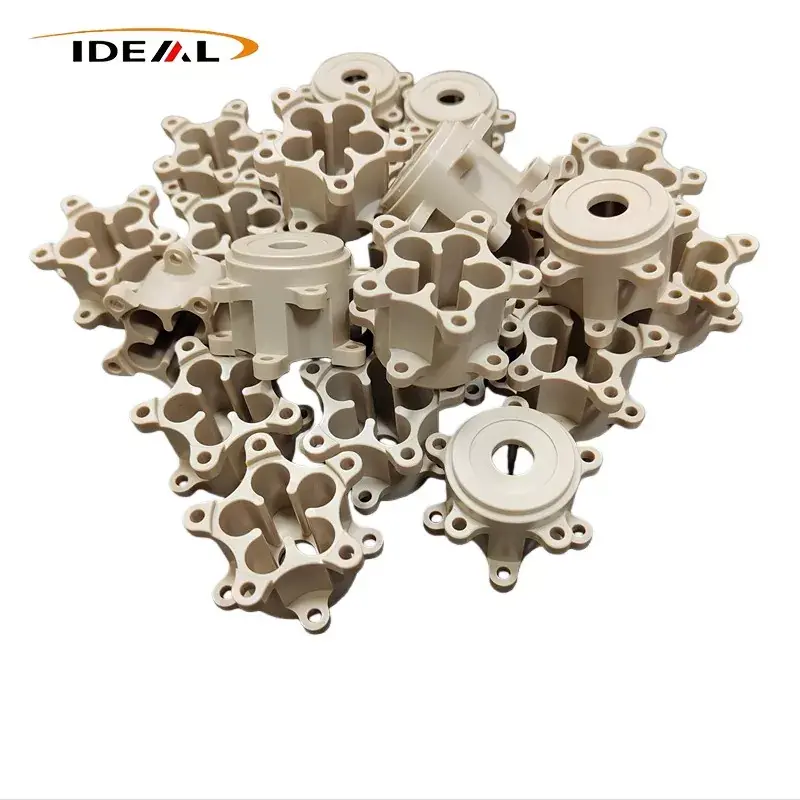
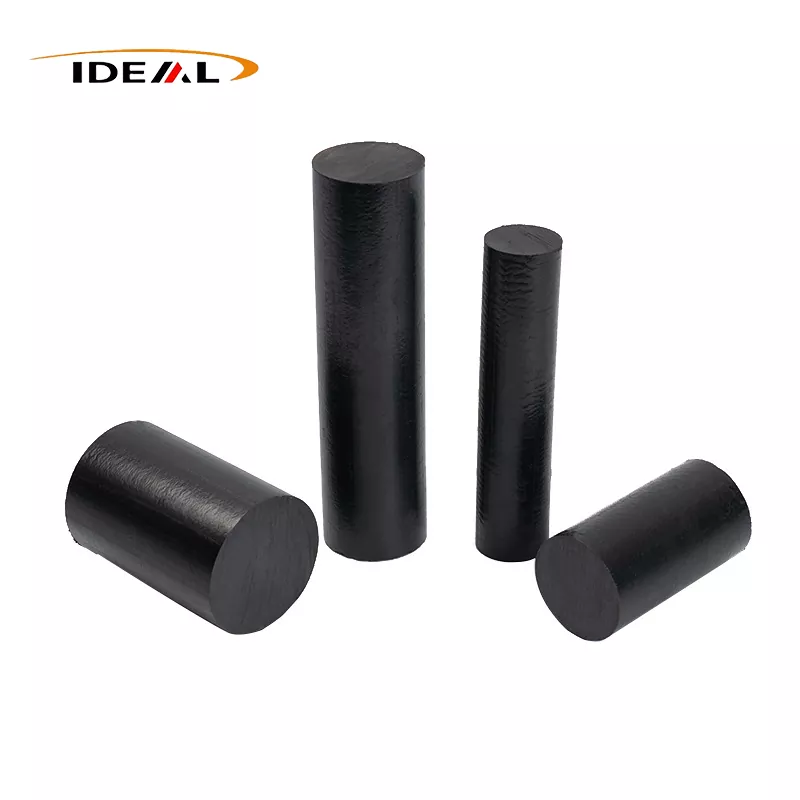
Choose carbon fiber filled PEEK sheets only after matching the formulation, supplied dimensions, tolerance basis and machining route to your finished part. Ideal Plastic lists black sheet in 600–1250 mm widths and 3–100 mm thicknesses, with standard and custom-size options. It also provides semi-finished profiles and custom components for U.S. and international customers.
Those dimensions are useful starting points, not a substitute for a material review. Carbon-fiber loading, resin grade, fiber orientation and electrical behavior can change the result. Send the drawing and operating requirements before approving a carbon fiber filled PEEK sheet for production.
When Carbon Fiber Reinforced PEEK Sheet Fits the Part Requirement
Carbon fiber reinforced PEEK sheet is considered for precision components where unfilled PEEK may not provide the required stiffness, dimensional response or wear behavior. The compound can also be relevant when a buyer needs a black engineering-plastic plate that can be CNC machined into tight-tolerance features.
Start with the failure mode you need to prevent. Is the concern deflection under load, dimensional movement, friction, wear, electrical charge, chemical exposure or loss of properties at operating temperature? A carbon-filled grade isn’t automatically the right answer to all six. Each requirement needs supporting data for the exact formulation.
Don’t select by color or the phrase “carbon fiber PEEK” alone. Black appearance doesn’t establish fiber percentage, conductivity, static-dissipative performance or suitability for contact with a specific process chemical.
Select the Grade by Verified Formulation and Performance Data
Ask for the grade identification and applicable data sheet before issuing a purchase order. Buyers searching for “PEEK CF30 sheet,” for example, may expect a particular carbon-fiber loading. That loading has not been specified here and shouldn’t be assumed from the product category.
Compare supplier data against the conditions on your drawing or material specification. Relevant items may include mechanical properties, temperature conditions used during testing, dimensional stability, wear data and electrical measurements. Use values tied to the offered grade rather than generic values copied from another carbon-filled PEEK compound.
Confirm Carbon-Fiber Loading, Base Resin, Fiber Direction and Test Methods
Four details prevent many approval problems: carbon-fiber percentage, base-resin identity, fiber distribution or direction, and test method. Extruded and compression-molded stock may not behave identically because processing can affect fiber orientation and part response.
Test direction matters too. A value measured along the primary flow or extrusion direction may not represent performance across the sheet thickness. Ask how specimens were cut, conditioned and tested if directional properties affect your design.
Conductive, Static-Dissipative and Anti-Static Behavior Are Not Interchangeable
Carbon fiber can affect electrical behavior, but it doesn’t prove that every carbon fiber PEEK sheet is conductive, static-dissipative or anti-static. Those labels refer to different resistance ranges and application needs.
Define the required resistance range, measurement method, specimen geometry and environmental conditioning. If charge control is safety- or process-critical, request grade-specific test results and decide whether incoming inspection or lot testing is required. Don’t approve electrical performance from filler description alone.
Confirm Sheet Sizes, Imperial Equivalents and Tolerance by Ordered Dimension
Ideal Plastic publishes the following dimensional range. Imperial figures below are approximate conversions for planning; your purchase order should identify the governing unit and required finished dimensions.
| Item | Published offering | What to confirm on the RFQ |
|---|---|---|
| Color | Black | Grade identification and appearance requirements |
| Width | 600–1250 mm, approximately 23.62–49.21 in. | Available stock width, edge allowance and cut-size tolerance |
| Thickness | 3–100 mm, approximately 0.118–3.937 in. | Nominal versus finished thickness and measurement method |
| Stated tolerance | ±0.02 mm, approximately ±0.0008 in. | Which dimension and process the tolerance covers |
The stated ±0.02 mm tolerance needs context. Ask whether it applies to thickness, width, cut blanks or machined features, and whether it is available across the full size range. Also define where thickness is measured, required flatness and any allowance needed for final machining. A sheet can meet thickness tolerance yet still be unsuitable for a part that has demanding flatness or parallelism requirements.
Match Surface Condition and Machining Route to the Finished Geometry
Ideal Plastic describes extrusion, compression molding, injection molding, CNC machining, laser cutting, and four- and five-axis machining capabilities. The right route depends on geometry, quantity, tolerances, surface requirements and material availability.
For a rectangular blank, provide cut length, width, thickness and acceptable edge condition. For a finished component, send a controlled drawing rather than a marked-up screenshot. Identify datums, critical bores, threads, thin walls, sealing faces and inspection points. Carbon-filled material can be more demanding on cutting tools than unfilled resin, so tool condition and machining strategy matter when edge quality and dimensional consistency are critical.
If you’re comparing semi-finished stock with finished parts, request both options through the carbon fiber PEEK sheet and machining service page. This makes material allowance and responsibility for final dimensions explicit.
Evaluate Application Limits Before Approving the Material
Carbon fiber reinforcement involves trade-offs. It may change toughness, surface finish, electrical behavior and machining response compared with unfilled or glass-filled PEEK. A glass-filled grade shouldn’t be treated as an interchangeable lower-cost substitute without comparing the properties that govern the part.
Qualification may also depend on continuous and peak temperature, load duration, mating material, pressure, wear debris, sterilization, chemical concentration or regulatory status. If the application has a mandatory industry standard, state it on the RFQ; don’t assume a general material description covers it.
Aerospace, Automotive and Industrial Parts: Validate Loads, Temperature, Wear and Chemical Exposure
For structural supports, wear components, fixtures and equipment parts, define static and cyclic loads, operating temperature, exposure time and contact chemicals. Include mating surfaces and lubrication conditions where friction or wear controls service life.
Prototype results can be misleading if the test omits thermal cycling, sustained load or actual chemical concentration. Validation should reflect the installed part, not just a room-temperature inspection of a machined sample.
Semiconductor and Electronics Parts: Define Electrical, Contamination and CMP Retaining-Ring Requirements
Semiconductor and electronics buyers may need controlled electrical behavior, low contamination, traceability or documented cleaning and packaging. Put those requirements in writing. The presence of carbon fiber doesn’t establish extractables, particle behavior, ionic cleanliness or charge-decay performance.
For a carbon fiber PEEK sheet intended for a CMP retaining ring, supply the finished geometry, process environment, mating materials, wear criteria and any groove or hole details. Confirm material qualification and inspection requirements before machining; the product category alone doesn’t establish suitability for a particular CMP process.
Request a Quote with Drawings, Quantity, Machining Scope, Traceability, Test Records, REACH or RoHS Documents, Sample Needs and U.S. Delivery Details
A useful RFQ should include:
- Grade or required formulation, including carbon-fiber loading if specified
- Sheet or finished-part dimensions, tolerances, datums and surface requirements
- Order quantity, forecast quantity and requested delivery date
- Blank cutting, CNC machining, laser cutting or inspection scope
- Lot traceability, certificate or test-record requirements
- Required REACH or RoHS documentation and the applicable declaration scope
- Sample size, test purpose and acceptance criteria
- U.S. ship-to location, packaging needs and preferred delivery terms
Ideal Plastic references ISO 9001:2008, REACH and RoHS on its site. An ISO reference concerns the quality-management system; it isn’t the same as product certification. Ask for current documents, scope and grade-specific declarations required by your organization. Free samples are listed as available, but confirm size, grade and shipping terms.
Send your drawing and qualification questions through the Carbon Fiber Filled PEEK Sheets product page. Specify whether you need standard stock, a custom-size plate or fully machined components so the quotation addresses the actual manufacturing scope.