




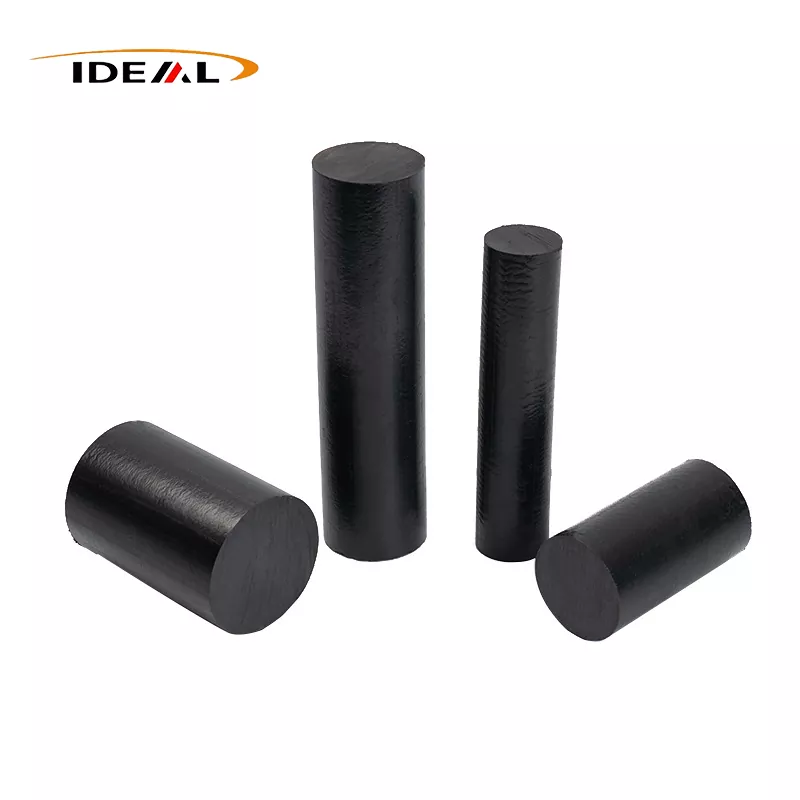
Specify the exact carbon-fiber formulation, finished or stock dimensions, tolerances, quantity, required documents, machining scope and delivery destination. Do not send an RFQ that says only “carbon PEEK rod.” That leaves the supplier to interpret the filler level, stock allowance and inspection requirements—three details that can change the quoted material and price.
A quote-ready request starts with grade, dimensions, quantity, documentation, machining scope and delivery destination
Give the supplier enough information to quote one defined item. Ideal Plastic’s carbon fiber filled PEEK rod listing covers black rods, carbon-fiber levels from 15% to 30%, diameters from 5 to 300 mm, and lengths of 1,000 or 3,000 mm. Those published ranges are a starting point, not a complete purchase specification.
A useful RFQ identifies:
- Material grade or requested carbon-fiber percentage
- Rod diameter, length, units and quantity
- Dimensional tolerance, straightness and surface requirements
- Required machining allowance or finished-part drawing
- Datasheets, inspection records, traceability and compliance documents
- Requested delivery date and full U.S. shipping destination
If your approved-material list names a manufacturer or grade designation, include it. If alternatives are acceptable, say so and require Ideal Plastic to identify the proposed equivalent before you approve the quote.
Specify the actual carbon-fiber grade rather than ordering by product family alone
Carbon fiber reinforced PEEK rod is a product family, not a complete grade description. A 15% formulation and a 30% formulation should be quoted as separate materials. Ask the supplier to state the resin grade, carbon-fiber content, basis used for the percentage and manufacturing route on the quotation and order acknowledgment.
Filler level can affect machining behavior and finished-part performance, but percentage alone does not establish mechanical, thermal or electrical properties. Compare grade-specific data under applicable test methods instead of treating every carbon-filled PEEK round bar as interchangeable.
Identify 15% and 30% carbon fiber formulations separately, and do not assume PEEK CF30 rod stock is electrically conductive without grade-specific data
If you need 30% carbon fiber filled PEEK rod, write that requirement explicitly rather than using “CF PEEK.” Use the same discipline for a 15% formulation. If either loading is acceptable, request separate quote lines so purchasing and engineering can see the difference.
Do not use the label PEEK CF30 as proof of electrical conductivity. Conductive behavior depends on the actual formulation, fiber distribution, test direction, specimen preparation and test method. If conductivity or static dissipation is a design requirement, state the required property and ask for grade-specific test data. A black appearance or carbon-fiber designation isn’t sufficient evidence.
Correct any quotation, datasheet or product table that describes the rod as glass-fiber-filled PEEK
Ideal Plastic’s carbon-fiber rod page contains a material-table inconsistency that labels the product as glass-fiber-filled PEEK. Resolve that conflict before issuing a purchase order. Ask for a corrected quotation, datasheet and order acknowledgment that all identify the same carbon-fiber-filled grade.
This isn’t clerical nitpicking. Carbon and glass reinforcement are different material specifications. Receiving inspection cannot reliably settle the issue from color or appearance alone, so the commercial and technical documents need to agree.
Confirm whether the listed 5–300 mm diameters and 1,000 or 3,000 mm lengths are in stock or made to order
The published size range does not establish inventory status. Ask whether your diameter, length and grade are available as stock, scheduled for production or made only after an order. That distinction affects lead time, sample availability and the practical minimum quantity.
Also clarify whether the quoted diameter is a nominal stock size or a controlled finished dimension. Rod intended for machining often needs enough material for cleanup, but excess stock increases cutting time and waste. Let the part drawing and machining plan determine the allowance.
State diameter, cut length, units, quantity, dimensional tolerances, straightness needs, surface condition and machining allowance
A complete line item should include all of the following:
| RFQ field | What to state |
|---|---|
| Dimensions | Nominal diameter, cut length and units |
| Quantity | Number of rods, cut blanks or finished components |
| Tolerances | Permitted diameter and length variation; do not write “standard tolerance” without defining the standard |
| Geometry | Straightness, roundness or other drawing requirements that affect use |
| Surface | As-produced, machined or another required condition |
| Allowance | Material that must remain for your machining and final inspection |
If you plan to cut a 3,000 mm rod into shorter blanks, tell the supplier whether full-length material is acceptable. If not, provide cut lengths, quantity per length, cut-end requirements and any restrictions on mixed production lots.
Require technical evidence tied to the quoted grade and production lot
Request documents for the material actually being quoted—not a generic PEEK brochure. The grade name, filler description and product form should match across the quotation, datasheet, packing documents and any inspection certificate.
Request the grade datasheet, applicable test methods, inspection records, lot traceability and any required RoHS, REACH or other compliance documentation
List every required document in the RFQ so its cost and availability can be addressed before ordering. Depending on your quality system, that may include the grade datasheet, stated test methods, dimensional inspection results, certificate of conformance, production-lot identification and traceability records.
If RoHS, REACH or another regulatory declaration is mandatory, ask whether the document applies to the quoted grade and current production lot. Do not assume that a general company statement will satisfy your customer or auditor. Ideal Plastic’s published information does not, by itself, establish that every requested certificate or lot-level test record is available.
Decide whether you need semi-finished carbon fiber PEEK round bar or drawing-based custom components
Order rod stock if your team will handle sawing, turning, milling and inspection. Send a controlled drawing if you want Ideal Plastic to quote custom components. The company lists extrusion, injection molding, compression molding, CNC machining and laser cutting among its production capabilities, but the appropriate process depends on the geometry, quantity, tolerances and material form.
For drawing-based work, identify critical dimensions, inspection points, edge conditions, surface requirements and any features that must remain free of machining marks. Ask whether parts will be machined from semi-finished carbon fiber PEEK round bar or produced by another process. That answer matters for qualification and documentation.
Send Ideal Plastic a complete RFQ covering price, one-piece MOQ and sample terms, lead time, packaging, machining, shipping terms and the U.S. delivery address
The product page mentions a one-piece minimum order, samples and custom parts. Confirm that those terms apply to your selected grade and diameter. Ask whether a sample is free or chargeable, whether it comes from the intended production grade, and whether sample freight is included.
Your final RFQ should request unit and total price, quote validity, stock status, production lead time, document charges, machining cost, packaging method and shipment date. For U.S. delivery, include the city, state, ZIP code, commercial or residential status, and any dock or appointment restrictions. State the requested Incoterm and version so freight, insurance, duties, customs clearance and brokerage responsibilities are clear.
Send the specification and drawings through Ideal Plastic’s Carbon Fiber Filled PEEK Rods page, then require the final quotation to repeat the approved grade, dimensions, quantity and documentation scope before you place the order.