



Key Takeaways for Specifying Custom PEEK Sliding Bushings
- Choose the PEEK grade around the actual sliding pair, heat, media, and stiffness requirement—not a generic “high-temperature plastic” label.
- A complete drawing needs shaft information, operating motion, load direction, clearance intent, tolerances, and environmental details.
- Dry running can be a sound design choice, but it raises the stakes on shaft finish, alignment, heat removal, and filled-grade selection.
- Use CNC machining for prototypes and lower-volume custom geometries; evaluate injection molding when stable, repeatable volume justifies tooling.
- Ask for inspection and documentation requirements before quotation, especially where a bushing is installed in controlled equipment.
A PEEK bushing is rarely selected because it is simply “better plastic.” It is selected because a sliding joint needs a particular mix of temperature capability, chemical resistance, electrical behavior, low mass, nonmagnetic construction, or lubrication-free operation that a metal sleeve or rolling bearing does not handle well.
The first technical decision is the material family. Pure PEEK, carbon-fiber-filled PEEK, glass-fiber-filled PEEK, and PTFE/graphite-filled PEEK do not behave the same way against a shaft. They differ in stiffness, thermal movement, friction behavior, wear response, and the degree to which they may affect a mating surface. That distinction matters more than a broad material callout on a purchase order.
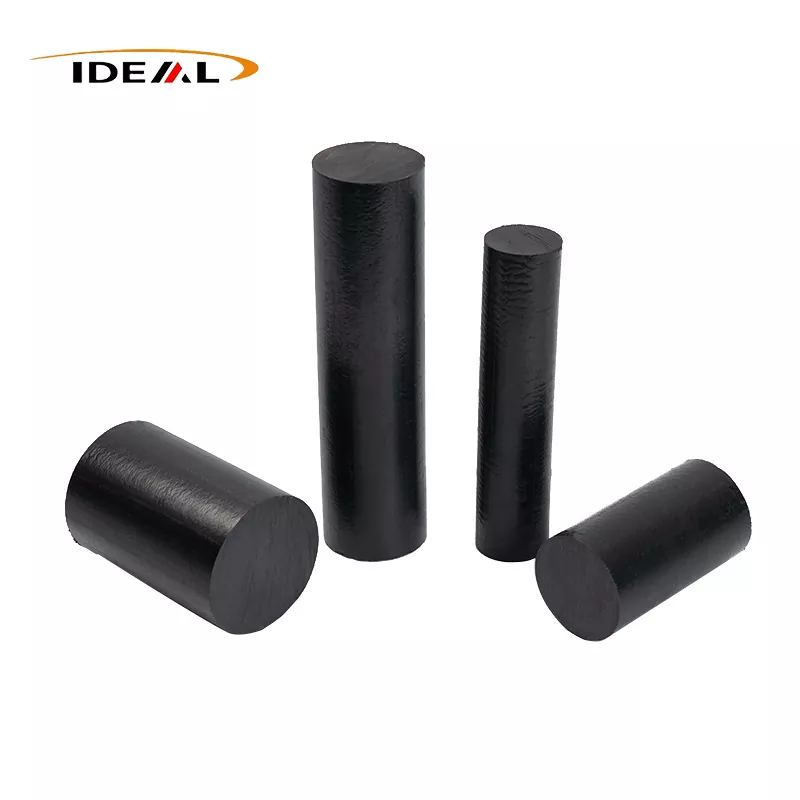
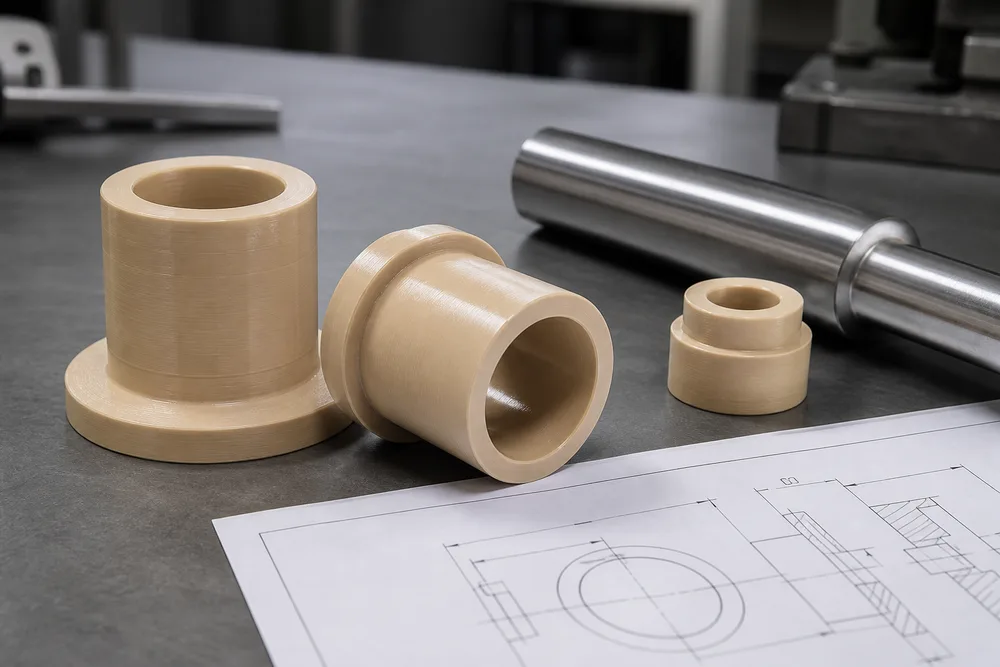
Ideal Plastic produces CNC machining from PEEK rods and tubes, a profile-to-finished-part process in which semi-finished PEEK stock is precision-machined into cylindrical, flanged, or stepped sliding-bearing components. Starting from rod or tube stock can make practical sense for custom drawings, prototypes, and changing dimensions because it avoids committing immediately to dedicated molding tooling. The trade-off is that machining strategy, stock geometry, and tolerance requirements need to be reviewed as part of the part design—not after the order is released.
For buyers comparing suppliers, begin with the actual bearing interface. A good custom PEEK bushing inquiry identifies the shaft, the bushing geometry, the movement, and the operating environment. That is enough to start a useful engineering conversation. “PEEK sleeve, quote please” is not.
FAQ: When Should You Choose Pure PEEK vs. Carbon-Fiber-, Glass-Fiber-, or PTFE/Graphite-Filled PEEK?
Direct answer: Choose pure PEEK where chemical resistance, electrical insulation, cleanliness, and baseline PEEK properties are central. Move to a filled grade only when the application has a specific need for altered friction, wear behavior, stiffness, thermal behavior, or dimensional stability. Filled PEEK is not an automatic upgrade; the filler changes the material’s priorities.
Pure PEEK is often the sensible starting point for a custom sliding bushing because it avoids introducing reinforcing or lubricating fillers into the system. That can be relevant in electrical or electronic equipment, chemical-related equipment, and assemblies where the buyer needs to assess material compatibility carefully. It can also be the cleaner design choice where a filler is undesirable in the contact zone.
Carbon-fiber-filled PEEK is typically considered when greater stiffness and improved dimensional behavior under heat are useful. Its electrical characteristics differ from pure PEEK, so it should not be substituted into an insulating application by default. Carbon-filled grades also require an honest review of the counterface. A shaft that works acceptably with one grade may not be the best long-term pairing with another.
Glass-fiber-filled PEEK is usually evaluated for added stiffness and dimensional stability. It is not a universal bearing material simply because it is reinforced. In a sliding interface, the shaft material, shaft finish, alignment, contamination, and contact pressure still decide whether the assembly survives. PTFE/graphite-filled PEEK is the grade family buyers commonly investigate for dry-running and self-lubricating behavior. It can reduce reliance on external lubrication, but dry operation does not remove frictional heat or forgive edge loading. If the bushing sees oscillation rather than full rotation, say so; oscillating movement concentrates wear in a small track and changes the selection discussion.
FAQ: What Drawing, Shaft, Load, Speed, Temperature, Chemical, Clearance, and Tolerance Details Should You Submit?
Direct answer: Submit the part drawing or a representative sample, then provide the shaft material and condition, motion type, load direction, speed or cycle pattern, temperature exposure, chemicals, lubrication plan, required clearances, and inspection-critical tolerances. The supplier needs the whole interface, not only the bushing’s outside diameter and length.
A usable drawing identifies bore diameter, outside diameter, length, flange dimensions where applicable, chamfers or radii, stepped features, and datum references. If fit is controlled by the finished assembly rather than a standalone dimension, communicate that plainly. A tolerance placed on a bushing bore without the mating shaft tolerance often creates an expensive guessing game.
Shaft information is regularly overlooked. State shaft material, surface treatment or coating if used, surface finish requirement if known, and whether the shaft is polished, ground, plated, or otherwise treated. A polymer bearing does not see “steel” as a complete description. It sees the texture and hardness of the surface moving against it, any corrosion products present, and any geometry that can score or plow the bore.
Explain the motion in normal shop language: continuous rotation, intermittent rotation, short-angle oscillation, linear travel, frequent starts and stops, or static load with occasional movement. Include radial, axial, or combined loading and identify shock or vibration. Temperature should cover normal operation, excursions, and heat from nearby equipment. For chemicals, name the fluid, vapor, washdown agent, or process exposure rather than writing “chemical resistant required.” Clearance must account for assembly conditions and thermal expansion across the operating range. Finally, identify which dimensions truly need tight control. Tightening every callout raises machining effort without necessarily improving bearing life.
FAQ: When Is a PEEK Bushing a Better Choice Than a Rolling Bearing or Metal Bushing?
Direct answer: A PEEK bushing is often a stronger candidate where low maintenance, dry running, corrosion resistance, electrical isolation, low weight, or chemical exposure matters more than the lowest possible rolling friction. A rolling bearing remains the right answer for many high-speed, precision, and heavily loaded rotating systems. Do not force a polymer bushing into a job that needs rolling-element behavior.
Sliding bushings have fewer parts and can suit compact mechanisms, automation fixtures, semiconductor and electronics equipment, and chemical-related machinery where grease is unwanted or metal corrosion is an issue. A flanged design can also locate a component axially while carrying radial motion in one integrated part. That simplicity is valuable, particularly where relubrication would be awkward after installation.
There are limits. A dry-running PEEK bearing still produces heat at the interface. Misalignment can push contact onto one bore edge; shaft deflection can do the same. Debris that might merely make noise in a generously lubricated metal arrangement can rapidly score a polymer sliding surface. A thin wall may be difficult to hold round after machining or press-fit installation. These are design and assembly problems, not material defects.
Metal bushings can remain preferable where very high stiffness, heat transfer, established lubrication, or aggressive load capacity drives the design. Rolling bearings can be preferable where rotational accuracy and low torque are the governing requirements. The useful comparison is not “plastic versus metal.” It is the operating system: shaft, housing, load path, movement, temperature, media, maintenance access, and failure consequence. Review those conditions before selecting from PEEK sliding bushing options.
PEEK Bushing Material Comparison Table: Selection Considerations for Pure and Modified Grades
The table below is a selection aid, not a substitute for application review. Material names tell you the direction of a grade’s behavior; they do not establish the life of a finished part. Fiber content, PTFE/graphite modification, stock form, machining details, shaft condition, and operating conditions all influence the final result.
| PEEK material option | Where buyers commonly start | Key selection considerations | Question to resolve before release |
|---|---|---|---|
| Pure PEEK | General custom bushings needing baseline PEEK properties | Useful reference grade for chemical, insulation, and cleanliness needs; friction and wear depend strongly on the shaft pair. | Does the application need a filler, or is unfilled material the better fit? |
| Carbon-fiber-filled PEEK | Stiffer bearing components and applications sensitive to thermal dimensional change | Electrical behavior and mating-shaft interaction differ from pure PEEK. | Is electrical insulation required, and what shaft surface will run against it? |
| Glass-fiber-filled PEEK | Parts needing reinforcement and dimensional stability | Reinforcement can change wear behavior and should be matched to the counterface. | Will alignment, shaft finish, and contamination control protect the sliding interface? |
| PTFE/graphite-filled PEEK | Dry-running or self-lubricating sliding-bearing concepts | Designed for friction and wear considerations, but not immune to heat, edge loading, or poor shaft conditions. | Can the joint reject frictional heat and maintain alignment during operation? |
A common mistake is selecting PTFE/graphite-filled PEEK solely because the specification says “no grease.” Dry running is an operating condition, not a free pass. Another is using a reinforced grade without checking whether it changes a required electrical property. Tell the supplier what failure you are trying to prevent—galling, corrosion, lubricant contamination, bore growth, stick-slip, electrical continuity, or frequent service—and material selection becomes far more productive.
How to Source a Custom PEEK Bushing: From Drawing or Sample Review to Prototype and Volume Production
Custom sourcing works best as a controlled technical handoff. The buyer supplies the design intent; the manufacturer reviews the geometry against available PEEK profiles, machining access, part handling, and the likely production route. A sample can be useful, especially for a legacy machine, but it should be accompanied by the conditions that caused the original part to wear or fail. Copying a worn component without understanding the service problem can reproduce the same failure.
- Send the drawing or sample. Include revision status, quantities, annual demand if known, and any critical interface dimensions.
- Describe the operating joint. Provide shaft details, motion, load, temperature, media, lubrication approach, installation method, and known failure modes.
- Review material and manufacturability. Confirm whether pure or modified PEEK is suitable and whether the geometry favors rod, tube, or another production approach.
- Align on prototype requirements. Identify what must be inspected, what needs functional validation, and whether a first article or sample approval is required.
- Release volume production. Once dimensions and material are stable, discuss the economic and technical fit of machined production versus injection molding for mass orders.
Do not wait until production release to mention a press fit, a hard-to-access bore gauge, or a shaft coating. Those details influence both tolerancing and inspection. If you are buying for a U.S. plant through an international supply chain, clarify packaging, labeling, lot identification, shipping terms, and document expectations early as well. Those requests are normal procurement controls, not afterthoughts.
For a quote that can be evaluated rather than merely compared, send your package with the part’s function. Ideal Plastic can review custom-machined PEEK bushings against custom drawings or samples and discuss the practical production path.
Ideal Plastic’s PEEK Bushing Manufacturing Approach: CNC-Machined Profiles and Injection Molding for Mass Orders
Ideal Plastic, Guangzhou Ideal Plastic Technology Co., Ltd., manufactures PEEK, PAI, PI, PPS, PPSU, and PEI semi-finished profiles as well as custom machined and injection-molded components. Its PEEK range includes rods, sheets, tubes, customized products, machined products, and PEEK bushings. That matters because a bushing supplier should understand both the finished part and the stock form from which it is made.
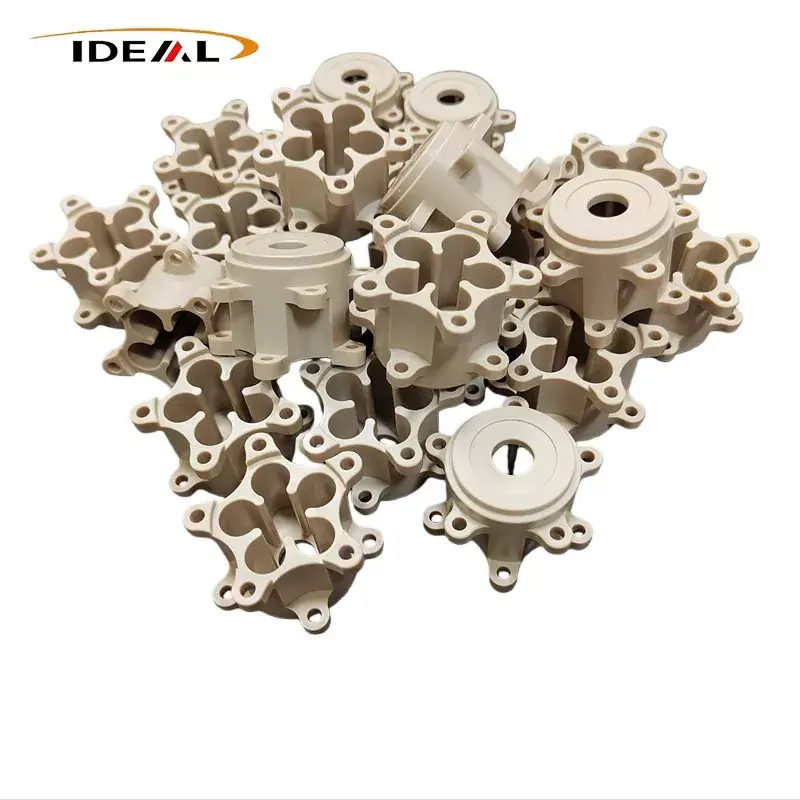
For PEEK bushings, the company describes cylindrical flanged and stepped sliding-bearing parts made by precision machining PEEK rods and tubes. CNC machining is particularly useful where a drawing includes nonstandard bore and outside-diameter relationships, flange features, steps, small quantity requirements, or design changes that make dedicated tooling premature. It also supports the practical reality of replacement parts: you may need a specific geometry for installed equipment rather than an off-the-shelf catalog size.
Injection molding enters the conversation for mass-production orders. The appeal is repeatability at volume once the design is proven and tooling is justified. The limitation is equally real: molding requires a stable design and a clear plan for tooling, part geometry, and production quantity. A buyer who expects prototype-like flexibility and molded-part economics in the same first order is setting up a difficult project.
Ideal Plastic identifies pure PEEK, carbon-fiber-filled PEEK, glass-fiber-filled PEEK, and PTFE/graphite-filled PEEK as available material options for these parts. Its stated application focus includes automation and precision machinery, semiconductor and electronics equipment, and chemical-related applications. Those sectors have different risks, so the best request identifies the equipment function rather than only naming the industry.
PEEK Bushing Terms and Documentation: Flanged and Stepped Bushings, Dry Running, OEM/ODM, Inspection, and Compliance Requests
A flanged bushing has a radial flange that can provide axial location or thrust support in addition to the main cylindrical bearing section. A stepped bushing changes diameter along its length, often to match a housing feature, locate the component, or create a controlled shoulder. Those names are useful shorthand, but they do not eliminate the need for a complete section view and datum strategy on the drawing.
“Dry running” means the bearing is intended to operate without added liquid or grease lubrication at the sliding interface. It does not mean the assembly has no maintenance considerations. Shaft cleanliness, alignment, thermal behavior, installation force, and inspection still matter. “Self-lubrication” is often used to describe a filled PEEK material designed to improve sliding behavior, particularly PTFE/graphite-filled PEEK. Treat it as a material feature to validate in the actual application, not a promise of indefinite life under any load and speed.
OEM/ODM requests should distinguish between building to your supplied drawing and seeking manufacturing input on a part concept. In either case, state ownership and revision-control expectations. For inspection, name the dimensions that require recorded results, the requested sampling or first-article process, and any marking or traceability needs. A supplier cannot infer your quality plan from a general statement such as “high precision required.”
Compliance requests deserve the same clarity. If your organization needs material declarations, restricted-substance information, certificates, or customer-specific documentation, ask for those documents during quotation and confirm what can be supplied. Do not assume a certification applies to a particular material grade, batch, or finished PEEK bushing unless it is explicitly confirmed in the agreed documentation package.
Request a Custom PEEK Bushing Assessment from Ideal Plastic: Submit Your Requirements at https://www.idealpeek.com/contact.html
Send Ideal Plastic the drawing, a dimensioned sample record, or both, along with your annual quantity range and the conditions at the shaft-to-bore interface. Include the PEEK grade you currently use if there is one, but also explain why you are changing suppliers or changing material. A recurring wear line, lubricant contamination, chemical attack, difficult maintenance access, or dimensional instability gives the review a concrete starting point.
For the fastest technical response, attach the latest drawing revision and identify the dimensions that govern fit and function. State whether the bushing is cylindrical, flanged, or stepped; whether it runs dry; and whether the part is for a prototype, replacement, or established production program. If you have a mating shaft drawing, include it. That single document often prevents the most avoidable mismatch in a sliding-bearing design.
Start a PEEK Bushing Review
Submit your drawing, sample details, material preference, application conditions, quantity, and inspection requirements to begin a custom bushing assessment with Ideal Plastic.
Visit Official Website →Use the contact page at idealpeek.com/contact.html to submit the package, then ask for feedback on grade selection, machining feasibility, prototype needs, and the appropriate route for your expected production volume.