


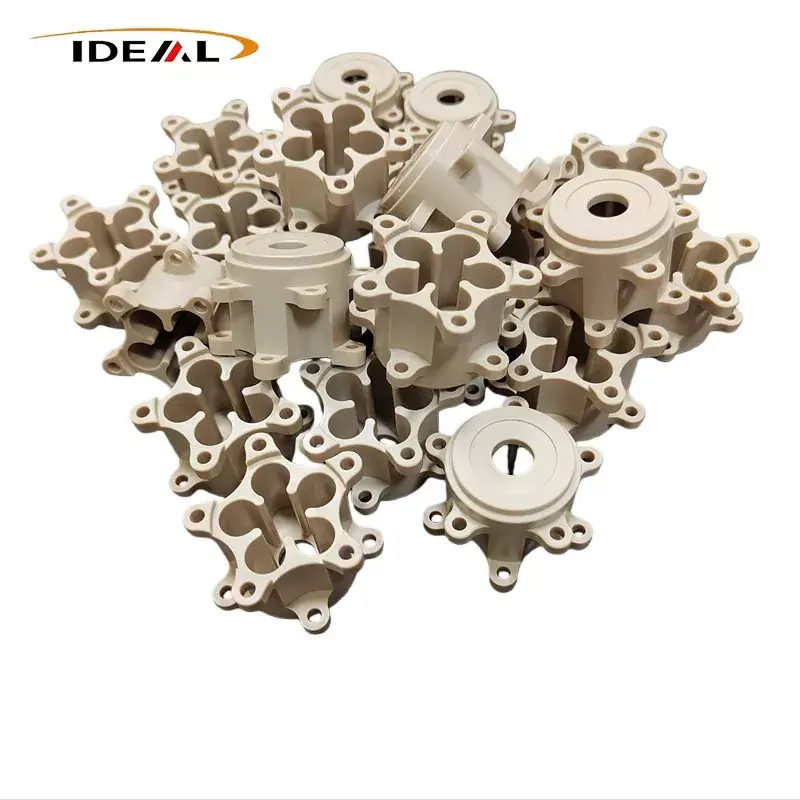
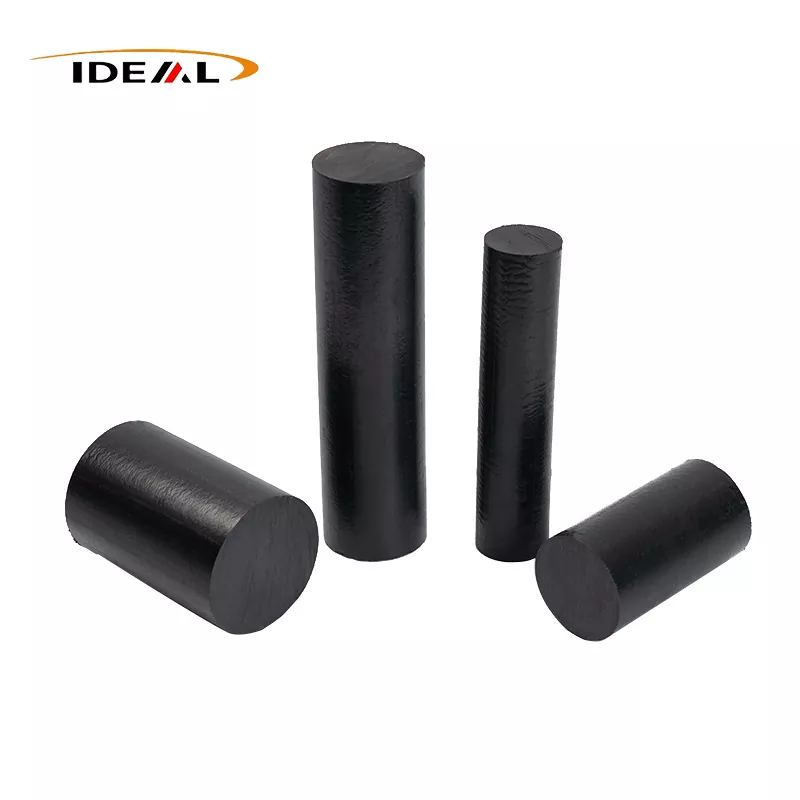
A China PEEK manufacturer can supply semi-finished PEEK profiles—sheets, rods, and tubes—or produce custom components through CNC machining and injection molding. Ideal Plastic manufactures these PEEK product forms from its Guangzhou factory and R&D center, helping buyers begin with the form and process that suit their drawing, geometry, and order requirement.
The right choice is rarely just “PEEK or not.” A flat wear pad, a turned sleeve, a thin-wall tube, and a molded repeat-production part can all start with PEEK, yet they call for different material forms and manufacturing routes. Getting that decision right early can avoid unnecessary machining, unsuitable tooling commitments, or a profile that leaves too little material for the finished feature.
Ideal Plastic Can Supply PEEK Profiles and Custom Parts Through Multiple Manufacturing Routes
Ideal Plastic supplies PEEK sheets, rods, tubes, CNC parts, injection-molded parts, and machining PEEK products. Its available manufacturing processes include extrusion, injection molding, compression molding, CNC machining, five-axis machining, laser cutting, and CNC engraving.
That range matters because semi-finished stock and finished components solve different purchasing problems. If your team has in-house machining capacity, a PEEK sheet or rod may be the practical purchase. If you need parts made to a drawing, a custom PEEK machined part may be the better route. For a repeat part whose geometry and volume justify a mold, injection molding should be assessed before committing to extensive material removal.
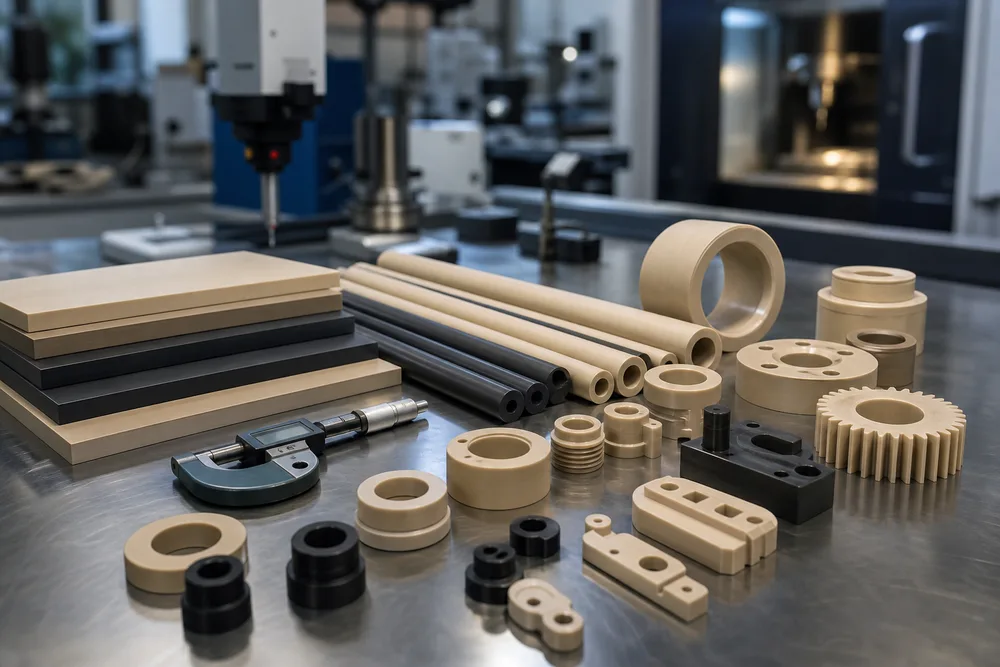
Available PEEK Forms: Sheets, Rods, Tubes, and Machined Components
PEEK profiles are selected by the starting shape that most closely matches the final part. This is not a minor purchasing detail. Starting with the wrong profile can increase machining time, create avoidable waste, or make it difficult to hold the wall section your drawing requires.
When PEEK Sheets, Rods, or Tubes Are the Right Starting Material
Choose PEEK sheet for parts developed from plate stock: flat components, blocks, panels, guides, or shapes that need milled pockets and cut-outs. A sheet can also be useful where the finished part has an irregular external outline that does not suit a round profile.
PEEK rod is usually the more sensible starting point for circular or turned parts, such as rings, bushes, spacers, and components with concentric diameters. Buyers often focus on outside diameter and overlook how much stock must remain around holes, grooves, threads, or other machined details.
PEEK tube is worth reviewing for hollow parts. It can reduce the amount of material removed compared with drilling a deep bore through rod stock. The key check is not just the tube outside diameter; it is the relationship between the supplied bore, the required final wall, and any secondary features that interrupt that wall.
From Semi-Finished PEEK Profiles to CNC-Machined and Injection-Molded Parts
Semi-finished profiles give you flexibility for development, repair, and low-commitment purchasing. Finished PEEK components shift the production work to the supplier. Ideal Plastic lists both PEEK sheets, rods, and tubes and custom manufacturing routes, so a project can be reviewed from either starting point.
CNC machining removes material from a profile or blank to create the specified form. Injection molding forms parts in a mold. Neither route is automatically superior. The decision turns on geometry, quantity, drawing maturity, and the commercial case for tooling.
Choose the Manufacturing Route That Fits Your Part Design and Order Requirements
Start with the final part, not the catalogue format. Ask how the part will be mounted, which surfaces mate with other components, what features need to be produced, and whether the order is a prototype, a small batch, or an established repeat requirement.
Choose CNC Machining for Drawing-Based Custom PEEK Parts and Complex Features
CNC machining is often the logical route for drawing-based custom PEEK parts, especially where the design includes pockets, side holes, steps, grooves, threads, angled surfaces, or features on more than one face. Ideal Plastic lists CNC and five-axis machining among its available processes.
For a machining enquiry, the drawing matters more than a general description such as “high-temperature plastic part.” Identify the critical dimensions, mating interfaces, feature locations, and any surfaces that must remain free from tooling marks. If you have a sample, photos can help explain the application, but they should not replace controlled dimensions.
There is a trade-off. Machining supports design changes without a production mold, but material removal and cycle time must be considered for repeat orders. Complex geometry can be achievable, yet each feature still needs access for cutters and a realistic workholding approach.
Consider Injection Molding When Part Geometry and Production Volume Support Tooling
Injection molding deserves consideration when the same PEEK part will be produced repeatedly and the design is stable enough to support mold development. It is not simply a cheaper version of machining. Tooling introduces its own cost, lead-time, and design decisions.
Review geometry early. Wall transitions, undercuts, draft requirements, gates, ejector locations, and cosmetic expectations can affect mold design and the finished part. A buyer who sends a machined-part drawing without discussing these points may discover late in the project that the molded design needs adjustment. Ideal Plastic lists injection molding as an available process for PEEK parts, so this route can be discussed alongside machined alternatives.
What to Send for a PEEK Sheet, Profile, or Custom Part Review
A useful request gives the supplier enough information to assess the correct PEEK form and process. Send what is known; do not guess at details that your engineering team has not approved.
- For sheets, rods, or tubes: required dimensions, quantity, and whether the profile will be machined after delivery.
- For custom parts: a current 2D drawing, 3D model where available, part quantity, and the revision status.
- For functional review: the application, mating parts, critical dimensions, and features that cannot be changed.
- For material selection: any stated material grade, compliance requirement, test request, or customer specification.
- For commercial planning: destination, preferred packaging arrangement, target delivery requirement, and whether the requirement is prototype, batch, or repeat production.
If you are unsure whether to buy stock or finished parts, state that directly. A proper review can compare a PEEK sheet, rod, or tube starting point against a quote for custom machining rather than forcing the project into a route chosen too early.
Confirm Material Claims, Quality Documentation, Packaging, and Delivery Before Ordering
PEEK is a material category, not a complete purchase specification. Confirm exactly what material designation your project requires and what documentation must accompany the order. Do not assume that a property, approval, traceability record, or test document is included unless it has been agreed in writing.
The same discipline applies to quality control. Clarify which dimensions are critical, how they will be inspected, what acceptance criteria apply, and what records you need with the shipment. For custom PEEK machined parts, the overlooked issue is often not the overall length or diameter—it is the feature position, thread, bore relationship, or mating surface that affects assembly.
Packaging should match the part. Thin sections, finished surfaces, and parts with delicate features may need protection from rubbing or deformation during transport. Confirm labeling, lot identification where required, carton or pallet needs, shipping destination, and delivery terms before production starts. International orders benefit from these decisions being documented rather than settled after the parts are packed.
Discuss Your PEEK Requirement With Ideal Plastic
Ideal Plastic serves customers in China and international markets, including Europe, the United States, the Middle East, Japan, South Korea, and Southeast Asia. Send your profile requirement or part drawing with the information above, and ask for the route that fits the part rather than the route that merely sounds familiar.
For PEEK sheets, rods, tubes, CNC-machined parts, or injection-molded component enquiries, discuss your PEEK requirement with Ideal Plastic and provide the drawing, quantity, application details, and documentation expectations from the start.