



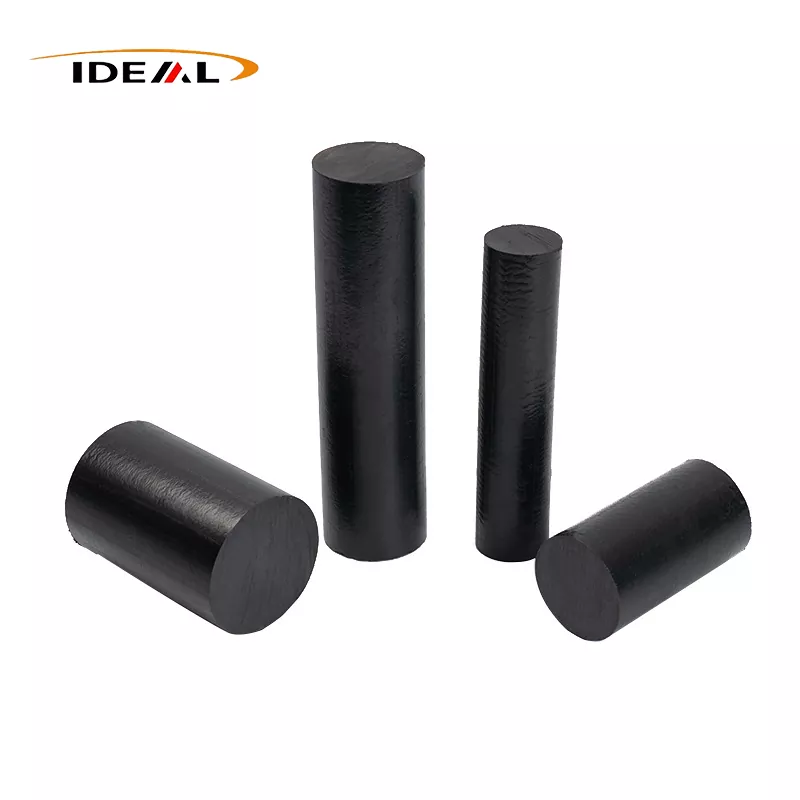
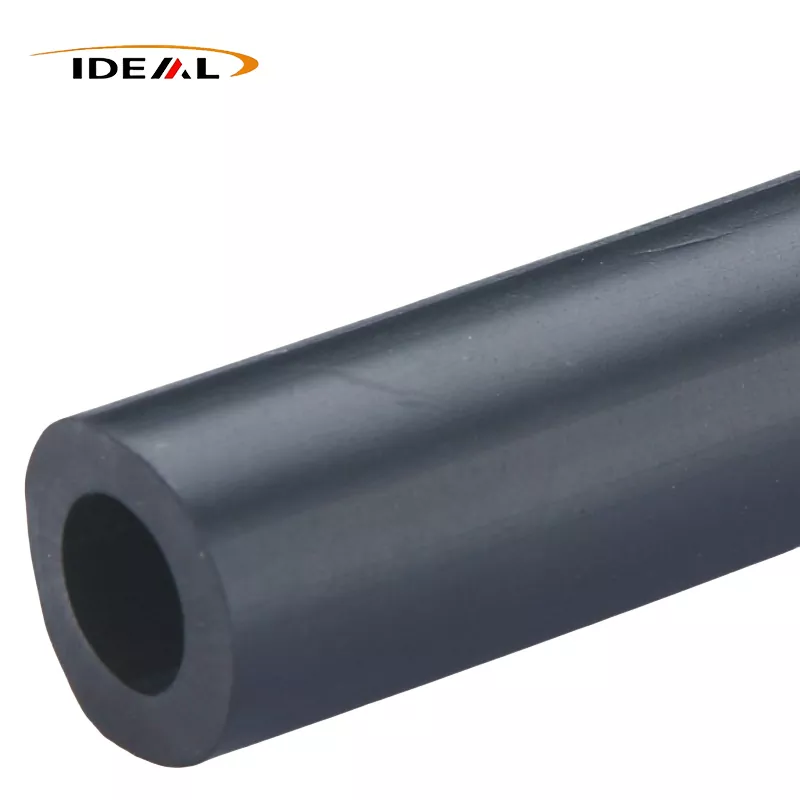
Carbon Fiber Reinforced PEEK Pipes are a practical choice when a standard PEEK tube needs more stiffness, dimensional stability, load capacity, or static control. Ideal Plastic produces black carbon-fiber-filled PEEK tubes with carbon-fiber content from 10% to 40%, LCF and SCF options, stated inside and outside diameter ranges, lengths of 1,000 mm or 3,000 mm, and tolerances down to ±0.02 mm.
The right grade is not selected by carbon percentage alone. Fiber length, wall geometry, operating temperature, wear conditions, electrical requirements, and the finished dimensions all affect the specification. Start with the load case and drawing, then request a quotation against a defined material and inspection requirement.
When Carbon-Fiber-Filled PEEK Tubes Are the Right Choice
Pure PEEK already provides a useful combination of temperature capability, chemical resistance, wear behavior, and dimensional stability. Adding carbon fiber changes the balance toward stiffness and load support. That matters in a tube used as a bearing sleeve, insulating or guiding component, structural passage, roller or transmission part, or other semi-finished profile that must hold its shape under stress.
Carbon fiber is usually worth considering when a pure PEEK tube deflects too much, expands beyond the fit window, or wears faster than the application allows. It can also help in static-sensitive systems. Ideal Plastic states volume resistivity as low as 1 × 10³ Ω·cm for its carbon-fiber-filled PEEK material range, but the required electrical performance should be confirmed for the exact grade, fiber content, geometry, and test method.
Do not treat a carbon-filled tube as an automatic replacement for every PEEK part. Carbon fiber can affect machinability, surface appearance, anisotropy, and electrical behavior. If the tube must remain highly insulating, if a very smooth contact surface is critical, or if the part is exposed to a chemical mixture not covered by existing data, ask for a grade-specific review before ordering.
Select Carbon-Fiber Content and Fiber Grade for the Load Case
What 10% to 40% Carbon Fiber Changes in PEEK
Ideal Plastic offers adjustable carbon-fiber content from 10% to 40%. In general, increasing the filler level shifts the composite toward greater rigidity and load support, while also making the material choice more sensitive to processing direction and the surrounding design. The highest percentage is not automatically the best value: it may be unnecessary for a lightly loaded tube and can complicate machining or surface requirements.
Specify the result you need rather than only asking for “carbon-filled PEEK.” Useful inputs include radial load, axial load, unsupported span, temperature range, sliding speed, mating material, duty cycle, chemical media, and whether the tube must dissipate static charge. Ideal Plastic states stiffness values in the range of 8 to 12 GPa for its carbon-fiber-reinforced PEEK offering. Treat that range as product-level guidance, not a substitute for a grade-specific datasheet or design validation.
LCF, SCF, and CF30 PEEK Tube Options
Fiber grade affects more than the label. LCF means long carbon fiber; SCF means short carbon fiber. Longer fibers may be useful where reinforcement efficiency and stiffness are priorities, while short-fiber compounds can be more suitable for conventional processing and detailed machined profiles. The actual outcome depends on fiber orientation, molding or extrusion conditions, wall thickness, and machining.
“CF30” commonly identifies a PEEK compound with approximately 30% carbon fiber, but the designation should be confirmed with the supplier. Ask whether the quoted CF30 PEEK tube is LCF or SCF, what tolerance applies after machining, and which property data belongs to that exact compound. This prevents a common purchasing mistake: comparing two materials by carbon percentage while overlooking different fiber forms and manufacturing routes.
Confirm Pipe, Tube, Profile, and Machined Dimensions Before Ordering
Specify OD, ID, Wall Thickness, Length, Tolerance, and Surface Finish
“PEEK pipe” and “PEEK tube” are often used interchangeably in supplier searches, but the quotation still needs a precise dimensional definition. Provide the outside diameter (OD), inside diameter (ID), wall thickness or its calculation, cut length, quantity, tolerance, end condition, and surface-finish requirement. State whether the dimensions are supplied as-extruded, cut, or machined.
Ideal Plastic lists 1,000 mm and 3,000 mm standard lengths and a stated tolerance of ±0.02 mm for its carbon-fiber-reinforced PEEK pipes. Confirm which dimensions that tolerance covers. A tight OD tolerance does not automatically mean the ID, concentricity, straightness, or end squareness carries the same tolerance.
Use a Drawing-Based Dimension Review to Prevent Fit Errors
Send a drawing when the tube fits over a shaft, into a housing, or into a sealing or bearing assembly. Mark the critical features instead of relying on a catalog description. The review should cover:
- OD and ID limits, including the required wall thickness;
- concentricity, straightness, and allowable ovality where the assembly depends on them;
- cut length, end squareness, chamfers, grooves, holes, or other machined details;
- material grade, LCF or SCF construction, and carbon-fiber percentage;
- inspection method, sampling plan, packaging, and documentation.
For custom carbon fiber PEEK tube dimensions, a drawing review is usually more useful than asking only for the nearest nominal size. It exposes fit risks before production and gives the supplier a clear basis for tooling, machining, and inspection.
Published Performance Data and the Limits of Comparison
Ideal Plastic states a heat deflection temperature above 315°C and continuous-use temperature up to 260°C for its carbon-fiber-reinforced PEEK product information. Those figures indicate high-temperature capability, but they do not mean a tube can carry its maximum mechanical load continuously at 260°C. Load, wall thickness, exposure time, stress concentration, and mounting all affect the usable design temperature.
The same caution applies to wear and chemical resistance. Carbon-filled PEEK is intended for demanding friction, wear, load, and chemical-exposure conditions, yet performance depends on the mating surface, pressure, velocity, lubrication, temperature, and actual chemical concentration. A chemical compatibility statement for PEEK should not be treated as approval for every solvent blend, process fluid, or temperature cycle.
Use published values to narrow the material choice, then verify the exact grade. Request a datasheet, sample, or application review when the consequence of failure is high. Ideal Plastic states that free samples are available, which can support a fit check or a controlled prototype test before a larger order.
Applications for High-Temperature, Wear, Chemical, and Static-Control Systems
Carbon fiber PEEK tubing is a strong candidate for industrial systems that combine heat with mechanical demand. Typical evaluation areas include:
- Load-bearing or transmission parts: carbon fiber can raise stiffness and reduce deflection compared with ordinary pure PEEK.
- Wear-focused assemblies: the composite is suited to applications involving friction and wear, but the mating material and pressure-velocity duty still need review.
- High-temperature tubing: the stated 260°C continuous-use figure and HDT above 315°C provide a starting point for thermal screening, not a complete design limit.
- Chemical-process components: assess the specific medium, concentration, temperature, and exposure duration rather than relying on the word “chemical-resistant.”
- Static-sensitive equipment: the stated low volume resistivity can be relevant where charge dissipation matters; confirm grounding and electrical test requirements for the finished part.
Carbon fiber is also frequently compared with glass fiber. The better choice depends on the target properties: carbon-filled PEEK is generally selected when stiffness, weight, wear behavior, or electrical dissipation is more important, while the final decision requires comparable grade data rather than filler names alone.
Request a Verified Carbon Fiber PEEK Tube Quote from Ideal Plastic
Send Ideal Plastic the drawing or a clear specification for your carbon fiber reinforced PEEK pipes. Include the application temperature, load, friction or wear conditions, chemical media, static-control requirement, OD, ID, length, tolerance, quantity, and delivery target.
Ask the quotation to identify the carbon-fiber percentage, LCF or SCF construction, applicable dimensional tolerances, inspection documents, sample availability, and whether the part is supplied as a tube or finished by machining. Ideal Plastic supplies semi-finished and machined PEEK profiles from Guangzhou, China, including tubes and custom components, with standard or custom lead times for international customers.
For a first review, use the custom carbon fiber PEEK tube quotation page and attach the drawing. A verified grade and dimension review will usually save more time than choosing a nominal CF30 tube and correcting the fit after production.