Ideal Plastic offers PEEK O-rings in standard AS568 and GB specifications, as well as custom non-standard sizes. Available in virgin PEEK and modified grades—such as carbon fiber or graphite-filled—these O-rings are manufactured using a combination of precision CNC machining and high-temperature injection molding. A comprehensive stress-relief annealing process effectively eliminates issues like deformation, swelling, and leakage caused by thermal cycling, ensuring dimensional accuracy and stability far superior to standard plastic seals. Get a quote!
The PEEK O-rings provided by Ideal Plastic manufacturer are rigid precision static sealing components. They are mainly designed for static sealing and low-speed, short-stroke micro-motion sealing, capable of meeting sealing requirements under extreme working conditions.
They precisely fill gaps between mating parts to effectively prevent liquid leakage, gas escape and vacuum loss. Meanwhile, they block external dust, impurities and contaminants from entering equipment, ensuring reliable overall sealing performance.
Featured with a round loop shape and circular cross-section, PEEK O-rings require standard O-ring grooves pre-machined on equipment for installation. Manufactured in compliance with AS568 US standards and national metric standards, they support large-scale standardized production with excellent universal compatibility.
PEEK O-rings are fundamentally different from PEEK gaskets and cannot be substituted arbitrarily. PEEK O-rings are applied for groove-type sealing to achieve stable static sealing and slight dynamic sealing. In contrast, PEEK gaskets feature flexible outlines, diverse thickness options and customizable profiles. They realize large-area sealing via flange surface compression and are suitable for various wide flat flange sealing surfaces.
It is strictly forbidden to replace flange gaskets with PEEK O-rings. The ultra-small contact area of O-rings will cause uneven compression on flange surfaces and greatly increase the risk of sealing failure.
Made of high-quality PEEK material, the product has a high melting point, poor melt fluidity and obvious crystallization shrinkage, delivering high structural stability and adaptability to harsh industrial working conditions.
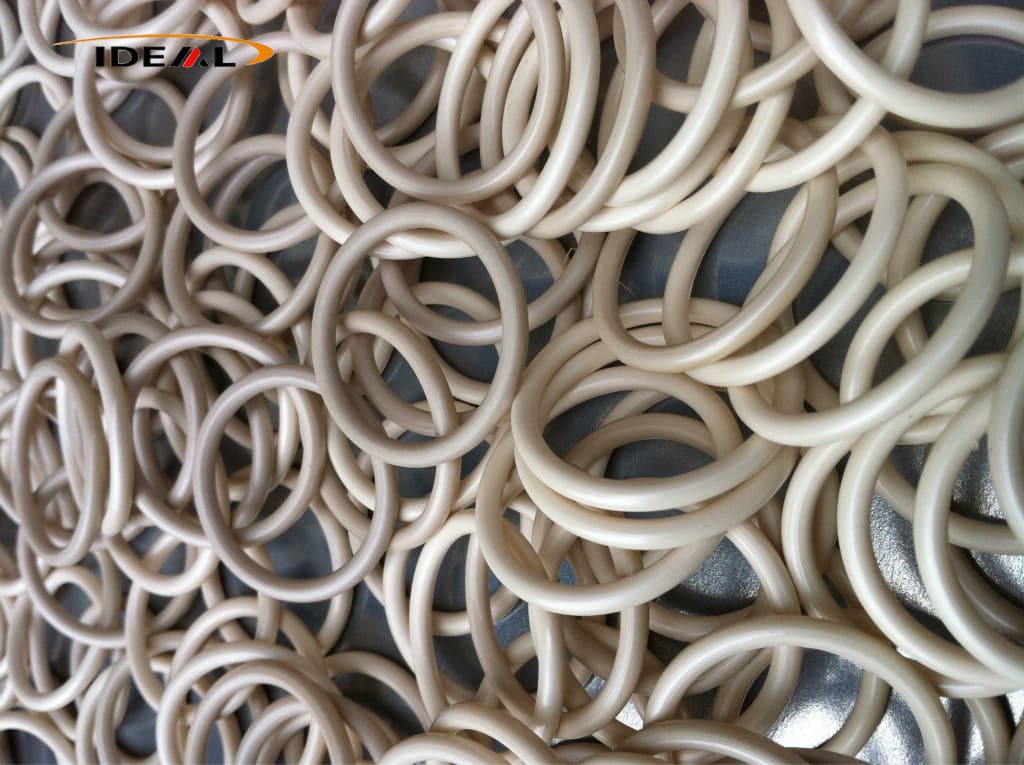
As rigid precision static sealing parts, the products are applicable to static sealing and low-speed micro-motion sealing under extreme conditions. They reliably prevent liquid and gas leakage, avoid vacuum loss, and isolate external contaminants, maintaining long-term stable sealing performance.
Adopting a standardized circular structure with round cross-section, the O-rings fit perfectly into standard annular grooves. The tight internal contact ensures stable static sealing and slight dynamic sealing effects.
Manufactured strictly in accordance with AS568 US standards and national metric standards, the products feature unified specifications, supporting large-scale industrial standardized production with strong universality and adaptability.
PEEK O-rings and PEEK gaskets have distinct application positioning. O-rings are specialized for groove-type sealing scenarios, while customizable PEEK gaskets adapt to large-area flat flange sealing. Arbitrary replacement is prohibited to avoid sealing failure risks.
Benefiting from the inherent properties of PEEK material, the products own high temperature resistance thanks to the high melting point. Their poor melt fluidity and significant crystallization shrinkage ensure high structural forming stability, suitable for long-term service in complex and harsh industrial environments.
The professional groove-type sealing structure ensures uniform compression and tight fitting. Different from the flat compression mode of gaskets, it effectively avoids uneven stress on flange surfaces and eliminates hidden dangers of leakage and sealing failure.
|
Item
|
Specification
|
|---|---|
|
Product Name
|
PEEK (Polyether Ether Ketone) O-Rings
|
|
Material
|
Unfilled PEEK, Carbon Filled PEEK, Graphite/PTFE Filled PEEK
|
|
Color
|
Black, Beige
|
|
US Standard AS568 Cross-section Diameter
|
1.78 mm (0.070"), 2.62 mm (0.103"), 3.53 mm (0.139"), 5.33 mm (0.210")
|
|
GB/T3452.1 Cross-section Diameter
|
1.80 mm, 2.65 mm, 3.55 mm, 5.30 mm, 7.00 mm
|
|
Sample Service
|
To be negotiated
|
|
Certifications
|
ISO9001, RoHS, REACH
|
|
Size Standard Classification
|
US Standard AS568 PEEK O-Rings, GB/T 3452.1 Standard PEEK O-Rings, Non-standard Customization
|
Compared with general-purpose plastics, manufacturing PEEK O-Rings poses much higher technical barriers. Two mature mass-production processes dominate the industry: precision CNC machining and high-temperature precision injection molding. The two methods differ greatly in finished part characteristics, suitable order volumes and overall cost brackets.
|
Processing Module
|
Detailed Description
|
|---|---|
|
Complete Production Workflow
|
Start with quality inspection of imported pure PEEK rod and sheet materials. The blanks undergo pre-annealing treatment to eliminate raw material internal stress in advance. After preliminary CNC turning to form annular semi-finished products, precision finish turning is carried out to optimize cross-section profile, followed by concentricity calibration. All workpieces will receive secondary stress-relief annealing to remove cutting residual stress, then go through surface polishing, burr removal and full-range dimensional testing before delivery.
|
|
Key Processing Challenges
|
Thin-wall annular PEEK workpieces are structurally fragile. Conventional clamping and cutting methods easily cause mechanical vibration and elastic deformation. After releasing the fixture, material rebound will lead to out-of-roundness, oval distortion and irregular shapes, resulting in poor assembly accuracy and hidden sealing leakage risks.
|
|
Customized Optimization Solutions
|
Equip customized flexible soft fixtures to disperse concentrated clamping pressure and avoid local extrusion deformation. Adopt large-area support positioning to enhance overall workpiece stability during processing. Match professional PEEK special cutting tools and reduce feeding speed to weaken cutting impact and vibration. Implement gradual fixture loosening after machining to prevent sudden stress release and permanent part deformation.
|
|
Processing Module
|
Detailed Description
|
|---|---|
|
Standard Molding Procedure
|
PEEK pellets are fully dried and dehumidified to eliminate moisture defects. Raw materials are melted evenly in the barrel at a constant temperature of 360–400°C, then injected at high pressure into a constant-temperature mold (180–210°C). Precise pressure holding is applied to standardize material crystallization, followed by graded slow cooling. After demolding, all parts undergo unified annealing stress relief, flash trimming and comprehensive dimensional verification to ensure qualified finished products.
|
|
Inherent Process Difficulties
|
PEEK material features high crystallinity and continuous shrinkage during the cooling and shaping phase. Slight fluctuations in molding temperature will directly cause inconsistent shrinkage of inner diameter and cord diameter, resulting in unstable dimensional tolerance and poor batch uniformity of finished O-rings.
|
|
Precision Control Measures
|
Implement closed-loop constant-temperature control for both barrel and mold to lock the temperature range steadily and minimize thermal variation. Fine-tune pressure holding time and cooling cycle parameters to balance material crystallization speed and shrinkage rate in all directions. Uniformize internal stress of finished products through post-molding annealing treatment, fundamentally improving dimensional stability of mass-produced PEEK O-rings.
|
Machined from solid virgin PEEK stock, PEEK O-rings are rigid precision static sealing components. Distinct from elastic seals manufactured from rubber, nylon, POM or standard PTFE, they deliver dependable sealing capacity in harsh environments where traditional sealing materials struggle to hold performance.
Supported by stable molecular composition, PEEK resists creep remarkably. Annealing treatment removes internal residual stress, enabling these O-rings to maintain tight contact against sealing surfaces amid fluctuating temperatures and continuous pressure. Equipment maintenance cycles can be greatly extended.
The material tolerates a wide range of lubricants, coolants and hydraulic fluids. It avoids swelling, dissolution or embrittlement when exposed to mild corrosive substances, suiting static sealing points on chemical pipelines and fluid processing systems.
Installed inside heating chambers and equipment with frequent temperature shifts, PEEK O-rings do not soften or deform like ordinary plastics. Original cross-sectional shape is preserved under load, preventing sealing gap expansion and persistent leakage under high-temperature static conditions.
PEEK base resin contains no plasticizers or volatile additives. Volatile release stays minimal at high temperatures, eliminating particle contamination inside sealed chambers. This property makes PEEK O-rings widely used for semiconductor wafer processing equipment, vacuum vessels and medical sterilization machinery.
Classified as rigid precision static seals, PEEK O-Rings stand out for high temperature tolerance, outstanding creep resistance, chemical inertness, low outgassing and inherent self-lubrication. They are primarily designed for static sealing and low-speed short-stroke micro reciprocating sealing, and are not suited for high-frequency long-travel dynamic reciprocating sealing services.
Virgin-grade PEEK features ultra-low volatility to avoid chamber contamination and resists creep-induced micro-leakage during long-duration vacuum operation.
These devices run with slight continuous motion and intermittent start-stop cycles, where regular grease refills are impractical. PEEK’s natural self-lubricating property enables maintenance-free operation.
Equipment faces drastic temperature fluctuations and chemical medium exposure; standard plastic seals easily swell and degrade in such environments.
It sustains cyclic temperatures ranging from -60°C to 260°C and resists deformation and leakage amid repeated thermal alternation.
- Specialized in custom PEEK O‑rings (rigid plastic sealing elements)
- Designed for high‑temperature, high‑pressure, vacuum, and corrosive environments
- Replaces traditional rubber seals for extreme working conditions
- Eliminates hidden leakage & intermittent sealing failure
- Resists creep deformation under long‑term high heat
- Reduces volatile outgassing & particle contamination in vacuum
- Ensures stable sealing performance in critical equipment
- Uses 100% virgin PEEK resin only
- No recycled materials for semiconductor, medical, and clean applications
- Materials selected based on working conditions, precision needs, and order volume
- Low outgassing, zero particle shedding, meeting strict cleanliness standards
- Manufactured to customer drawings or standard specs: AS568 / GB/T3452
- Strict control of inner diameter (ID) and cord diameter
- Curved sealing surface free of scratches, dents, pores, cracks, and inclusions
- No burrs, flash, or visible tool marks
- Mold parting lines located away from sealing areas (for molded parts)
- Mandatory annealing for all high‑end PEEK O‑rings
- Eliminates residual stress from machining and molding
- Prevents deformation, gap enlargement, and leakage caused by thermal cycling
- Ensures long‑term dimensional stability
- In‑house precision CNC workshops
- Supports customization by drawings or samples
- Capable of both CNC machining and precision injection molding
- Consistent quality for small batches and mass production
- Semiconductor manufacturing equipment
- Medical devices & sterilization systems
- High‑vacuum chambers and components
- New energy, chemical, and precision instruments
- Products exported globally
- Serves international customers in high‑end equipment industries
- Focus on long‑term, stable, and reliable sealing partnerships
A1: CNC machining requires no custom molds and delivers faster turnaround times. It supports fully non-standard custom dimensions and offers tighter stress control, perfectly suited for samples, small batch orders, as well as high-precision sealing applications in semiconductor and medical fields. Injection molding is cost-effective for large-volume orders of standard sizes, though mold fees apply and lead times are longer. You may share your drawings, order quantity and working conditions, and we will recommend the most suitable production solution accordingly.
A2: Annealing is strongly recommended for seals deployed in high-temperature, vacuum or continuously pressurized environments. For general applications at room temperature with low pressure, the process can be omitted to cut costs upon your assessment.
A3: Four common root causes are listed below:
① Grooves are designed to fit rubber O-rings, leading to mismatched compression rates;
② The seals skip annealing treatment and deform gradually as residual stress releases under service conditions;
③ Visible tool marks or burrs exist on sealing surfaces;
④ Poor machining accuracy of equipment grooves.
Kindly provide your operating parameters and groove drawings, and we will analyze the issue and propose targeted solutions.
A4: Careful evaluation is needed for scenarios with continuous heavy impact and severe high-frequency vibration. PEEK features high rigidity yet low elasticity, so it works best for static sealing. For heavily vibrating environments, we suggest optimizing groove structures or exploring filled modified PEEK grades as alternatives.