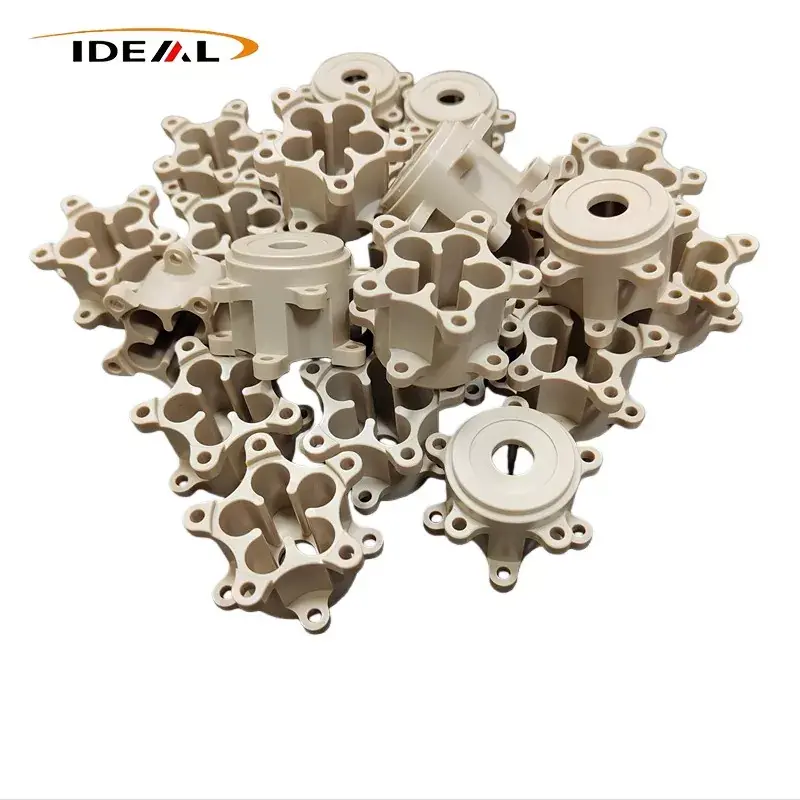
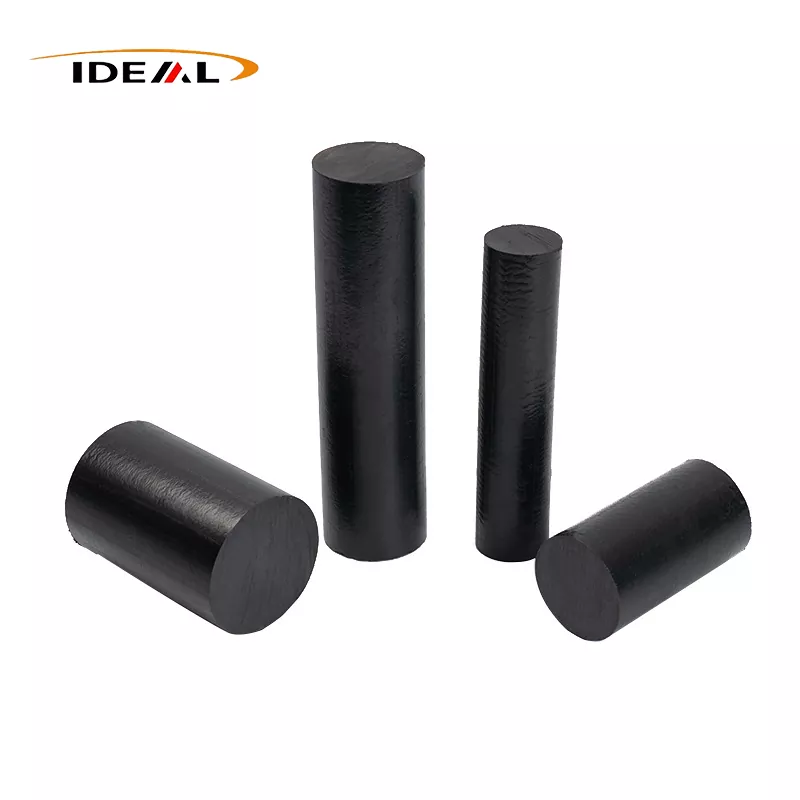
PEEK Set Screws, also commonly called PEEK Grub Screws, are made from high-performance polyetheretherketone (PEEK) substrate and precision CNC machined. They are headless set screws that rely on threaded locking to achieve component positioning, anti-loosening, and fixation. Containing no metal, they offer both high strength and adaptability to special working conditions. Guangzhou Ideal, as a source factory, serves a wide range of industrial equipment customers, supporting both standard in-stock and non-standard customization.
PEEK Set Screws from Ideal Plastic are precision CNC machined from virgin PEEK or 30% carbon fiber reinforced PEEK. Their headless design allows recessed installation for component positioning, axial fixing and anti-rotation where electrical insulation, non-magnetic properties, chemical resistance or temperature resistance are required.
| Product Name | Polyetheretherketone set screws |
| Material | Virgin PEEK, 30% Carbon Fiber Reinforced PEEK |
| Color | Black, Beige (Custom colors available) |
| Sizes | Metric, Imperial |
| Standard Metric Sizes | M2, M2.5, M3, M4, M5, M6, M8 |
| Common Imperial Custom Sizes | #4-40 UNF, #6-32 UNC, #8-32 UNC, #10-24 UNC, 1/4-20 UNC |
| Overall Length Tolerance | ±0.10mm; Precision annealing custom tolerances up to ±0.05mm |
| Thread Accuracy | Metric 6g, Imperial 2A, Go/No-Go gauge tested |
| Surface Roughness | Thread face: Ra≤3.2μm; Internal hexagonal groove wall: Ra≤1.6μm, Tightening end face: Ra≤3.2μm |
PEEK set screws use a headless structure with a complete external thread and an internal hexagonal drive. The screw can be fully recessed into a threaded hole, leaving no protruding head after installation.
The recessed design prevents the fastener from interfering with surrounding components. The tightening end contacts the mating part directly for positioning and fixation.
1. Fully threaded shaft for recessed installation.
2. Internal hexagonal groove for tightening.
3. Flat tightening end for direct contact with the mating component.
The main function is clamping and positioning rather than tensile fastening. The screw can hold shafts, sleeves and bushings in position, restrict axial movement and prevent relative rotation.
Insertion depth can also be adjusted to control component position or clearance, allowing the screw to function as a limit or adjustment screw.
Ideal Plastic provides virgin PEEK and 30% carbon fiber reinforced PEEK. Material selection depends on whether the assembly requires electrical insulation and non-magnetic performance or higher mechanical and wear-related performance.
Virgin PEEK provides high electrical resistivity, insulation and non-magnetic behavior. These properties are relevant to MRI equipment, high-voltage electrical equipment, new energy battery modules, semiconductor equipment and optical testing equipment.
30% carbon fiber reinforced PEEK is intended for high-temperature, wear-resistant and heavier-duty positioning applications where electrical insulation is not required. It should not replace virgin PEEK where insulation, non-magnetic performance or semiconductor cleanroom requirements are essential.
The small size, thin-wall threads and internal hexagonal groove make precision machining important. The supplied technical information states that industrial locking applications are mainly CNC machined from extruded PEEK bars rather than injection molded.
PEEK has high melt viscosity, making complete filling of small threaded structures difficult during injection molding. Weld lines, internal pores, shrinkage cavities and incomplete thread profiles can affect torque performance. CNC machining avoids these molding-related thread formation problems.
Ideal Plastic uses CNC lathes, CNC milling machines, CNC machining centers and five-axis machining centers. Processing uses suitable fixtures and sharp carbide tools, with cutting speed and feed rate controlled according to the small PEEK structure.
Extruded PEEK bars can contain residual stress. Material removal during machining may release this stress and cause dimensional changes or warping, particularly when the finished part is later exposed to elevated temperatures.
The supplied process therefore uses roughing and finishing stages with annealing where required. Stress control helps reduce the risk of thread cracking, internal hexagonal groove cracking, warping and dimensional drift.
Quality inspection covers material verification, first-piece inspection, in-process checks and final inspection.
1. The PEEK bar material and production batch are checked before machining.
2. First-piece dimensions, thread condition and appearance are verified.
3. Dimensions, appearance and tooling condition are checked during production.
4. Final inspection includes key-dimension sampling, visual inspection and torque testing of samples.
Thread gauges and torque testing are required because internal microcracks cannot be confirmed through visual inspection alone.
The required thread profile is complete and sharp, without burrs, rolled edges or burnt edges. Both thread ends have chamfered guides. The internal hexagonal groove has a smooth inner wall without opening damage, while the tightening end remains flat and free from tears or nicks.
The application of PEEK set screws is based on the material's thermal, electrical, chemical, mechanical and vacuum-related properties rather than general-purpose fastening.
1. High-temperature equipment: The supplied material information gives a long-term operating temperature range of 50℃ to 250℃, a glass transition temperature of approximately 143℃ and short-term peak temperatures of 280–300℃.
2. Electrical equipment: Virgin PEEK can provide insulation where metal fastening components could create conductive paths, short circuits or arcing risks.
3. Magnetic-sensitive equipment: The non-magnetic characteristics of pure PEEK are relevant to MRI, sensor and optical measurement equipment.
4. Semiconductor and vacuum equipment: High-purity virgin PEEK has low gas emission and low ion precipitation. After annealing, degassing and ultrasonic cleaning, it can be used in vacuum-related environments.
5. Positioning assemblies: The headless structure is suitable for shafts, sleeves, bushings and other components requiring recessed positioning or anti-rotation fixation.
PEEK set screws are positioning and clamping components rather than high-tensile fastening bolts. They are not intended for heavy-duty tensile connections.
Material selection should also follow the application requirements. Virgin PEEK is required when insulation, non-magnetic behavior or semiconductor cleanliness is important. Carbon fiber reinforced PEEK is intended for applications where higher mechanical and wear-related performance is needed without an insulation requirement.
A: External dimensions can meet DIN913/DIN916 requirements. High-temperature applications require consideration of thermal expansion and residual stress.
A: Annealing mainly reduces residual stress and improves long-term dimensional stability. It does not directly reduce machining tolerance.
A: No. Pure PEEK is required for insulation, non-magnetic and semiconductor cleanroom applications.
A: Imperial sizes are almost never stocked. They are CNC machined according to the required size and quantity.
A: Yes. Adjusting the insertion depth can be used to control component position or clearance.
A: Visual inspection alone cannot identify internal microcracks. Thread gauges and torque testing are used for verification.