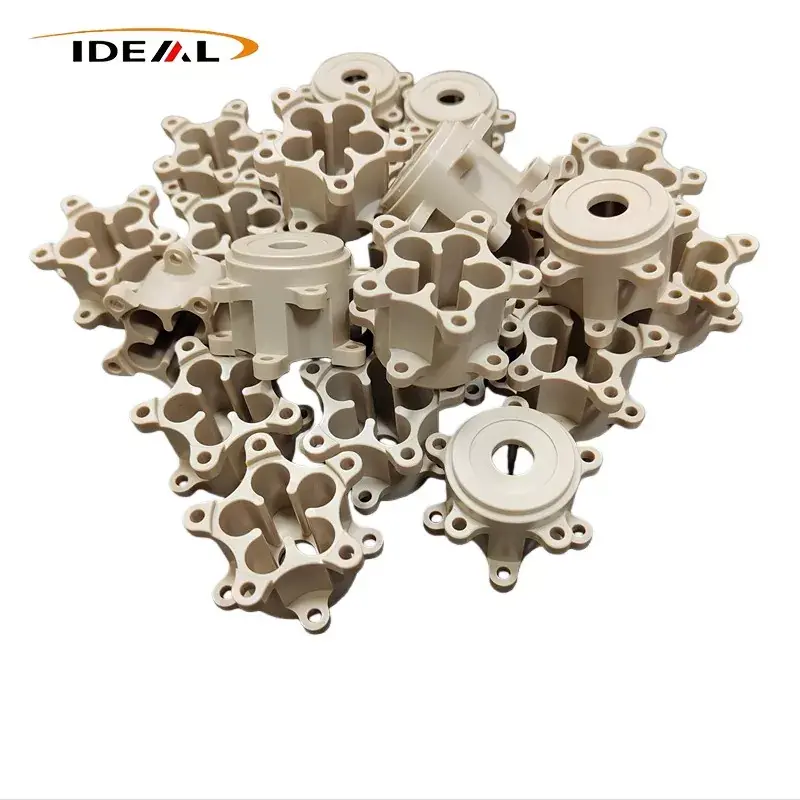
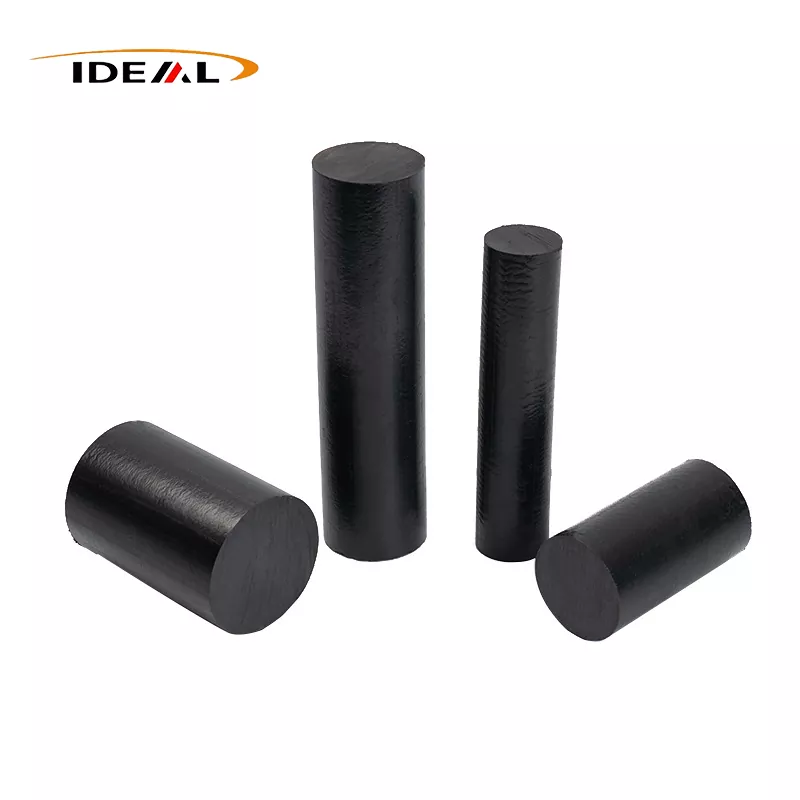
As a reliable China manufacturer, Ideal Plastic supplies DIN912 / ISO 4762 PEEK Socket Head Cap Screws in neat, CF and GF grades. These non-magnetic, insulating fasteners resist heat and corrosion for semiconductor, chemical and new-energy precision equipment, with neat PEEK showing 8–12% stress relaxation per 1000h at 200℃.
Ideal Plastic, a professional Chinese supplier of high-performance engineering plastic products, focuses on precision processing and custom manufacturing of PEEK Socket Head Cap Screws. Following DIN912 and ISO 4762 specifications, the factory leverages both injection molding and CNC machining to produce multiple material grades, including neat PEEK, carbon filled PEEK and glass filled PEEK. Every production batch goes through complete inspection and traceability control, targeting precision equipment environments where metal fasteners cannot meet insulation, non-magnetic or corrosion-resistant requirements.
| Product Name | PEEK hexagon socket cap head screws |
| Material | Unfilled PEEK, Carbon Filled PEEK, Glass Filled PEEK |
| Color | Black, Beige (custom colors available) |
| Thread Type | Metric (mainstream stock M1.6-M12), Imperial (customized for North American equipment) |
| Dimensional Tolerances | Standard parts tolerance: ±0.05-0.10mm, precision custom parts tolerance: ±0.02-0.05mm |
| Coaxiality | Hexagon head and screw coaxiality ≤0.03mm |
| Thread Accuracy | External thread 6g, mating internal thread 6H, Imperial UNC/UNF threads conform to ASME B18.3, tolerance class 2A |
| Metric Stock Sizes | M1.6, M2, M2.5, M3, M4, M5, M6, M8, M10, M12 |
PEEK Socket Head Cap Screws feature four core components: cylindrical head, internal hexagonal drive cavity, shank and threaded section. Although the outer geometry matches metal socket head cap screws, PEEK polymer material requires special structural adjustments to control stress concentration and prevent cracking during tightening or thermal cycling.
1. Rounded corner treatment: All transition zones at head root and hex cavity bottom are rounded. Sharp corners will create concentrated stress and trigger cracking when torque is applied to PEEK parts.
2. Hex cavity depth control: Cavity depth follows standard requirements. Insufficient depth leads to wrench slipping and inner wall damage; excessive depth reduces head wall thickness and lowers breaking torque resistance.
3. Thread profile optimization: Thread profile is thinner than metal fasteners. Thread tip uses rounded transition without sharp edges to reduce stress concentration at thread root and improve anti-slip performance. The lead-out end is chamfered to protect the first thread during assembly.
4. Surface quality standard: Filler reinforced variants cannot have micro-notches or chipping on hex inner walls. Tiny invisible defects will expand rapidly under mechanical load and cause unexpected fracture.
Even with simple appearance, these plastic fasteners require tight control of raw material, thermal processing, machining and inspection. Hidden defects may not show up in factory incoming tests and only fail during customer assembly or extreme temperature cycling. Main production difficulties are focused on internal stress relief, thread forming, filler processing and crystallization management for injection molded products.
There are multiple hidden risks in manufacturing PEEK fasteners, and each processing stage needs precise control.
1. Residual stress management: PEEK rods retain extrusion stress after extrusion. CNC cutting introduces additional cutting stress from tool pressure and cutting heat. If annealing duration is inadequate or heating/cooling speed is too fast, stress cannot be fully released. Products may pass dimensional inspection, but thread distortion, shank deformation and head cracking will occur after long time storage and temperature cycling.
2. Tool wear and filler cutting: Carbon filled and glass filled PEEK contain hard fillers that wear cutting tools quickly. Worn cutting tools produce thread burrs, tooth chipping and damage inside hex cavities. These subtle defects are hard to identify visually, yet cause thread stripping and head fracture during tightening operations.
3. Crystallization control for injection molding: The most critical point of injection molding is crystallization rather than outer appearance. The mold temperature must stay between 160-200℃ for full crystallization. Low mold temperature leaves incomplete crystallization; products look intact but lose heat and chemical resistance, followed by shrinkage and warping. This defect cannot be found by simple visual inspection. PEEK melt has high viscosity, and filled grades have worse fluidity. Poor gate and vent design causes trapped air, burning marks and internal micro voids. Post-molding annealing remains mandatory to avoid later deformation risk.
Guangzhou Ideal sets six core inspection dimensions for PEEK Socket Head Cap Screws: raw material quality, processing technology, thread precision, appearance, mechanical properties, batch traceability.
1. Raw material control: Only virgin PEEK rods and pellets are adopted; recycled material and material mixing are forbidden. Raw material moisture is controlled ≤0.02% to avoid bubbles, scorch marks and reduced mechanical strength. COC raw material certificates can be supplied, supporting batch traceability for semiconductor and medical projects.
2. Gradient annealing: CNC blanks and injection molded goods go through gradient annealing for stress relief. Heating and cooling speed are strictly regulated to remove extrusion, cutting and molding stress. Finished parts cannot retain high residual stress, preventing thread twisting, shank deformation and head cracking under temperature cycles.
3. Thread gauge inspection: Metric thread reaches grade 6H accuracy. Imperial threads comply with ASME B18.3. GO gauge screws in smoothly while NO-GO gauge cannot enter. 100% GO / NO-GO gauge inspection is implemented. Complete thread profile without missing teeth, tearing, chipping and burrs; tooth crest uses rounded transition and sharp tips are prohibited. Thread surface is free of scorch and extrusion damage, no cutting debris trapped inside thread gaps.
4. Visual appearance check: Cylindrical head surface is flat. Inner hex cavity has no chipped corners, notches, cracks, scorch or impact damage. Screw body must be free from cracks, delamination, bubbles, black spots and color impurities. Thread surface has no burrs or broken edges. Filler grades maintain uniform color without filler agglomeration spots.
5. Destructive torque test: Same-spec samples run destructive torque tests to record torque reference value. Head torque resistance test requires thread stripping to happen before head breakage; premature head fracture is not accepted.
6. Batch consistency & packaging: Same batch goods keep consistent color, dimension and mechanical performance. Separate packaging is used with clear labels showing specification, material grade and batch number. Cleanroom grade products are packed in dust-proof containers to avoid impurity contamination in transit.
PEEK Socket Head Cap Screws uses polyetheretherketone (PEEK) as its base material and comes in three grades: pure PEEK (natural insulation), glass fiber reinforced PEEK, and carbon fiber reinforced PEEK (conductive/antistatic). It boasts comprehensive advantages including high temperature resistance, corrosion resistance, insulation, non-magnetic properties, and lightweight construction, making it widely used in semiconductor, chemical, new energy, and medical equipment fastening applications.
1. High-Temperature Stress Attenuation Law: PEEK exhibits slight creep and stress relaxation above 200℃: the clamping force decreases slightly over time (an inherent characteristic of plastic polymers). Pure PEEK relaxation rate: 8–12%/1000h@200℃. Glass fiber reinforced PEEK relaxation rate: 3–5%/1000h@200℃ (significantly improved, suitable for long-term high-temperature pressure holding). Carbon fiber PEEK relaxation rate: 2–3%/1000h@200℃ (optimal, preferred for high-end equipment).
2. Inert Molecular Structure and Anti-Contamination: PEEK's main chain has a stable structure of benzene rings + ether bonds, resulting in no plasticizers, lubricants, or additives precipitating, and zero metal ion release. It contains no low-molecular-weight volatiles, preventing fogging and contamination of cavity lenses in a vacuum environment. Semiconductor, optical, and ultrapure water equipment only recognize pure PEEK CNC annealed parts to eliminate trace amounts of contamination.
3. High-Frequency Dielectric Constant and Stability: PEEK has a dielectric constant of 3.2–3.3, with almost no fluctuations in the 1GHz–10GHz high-frequency range. It exhibits extremely low dielectric loss, preventing interference with RF signals and signal drift. Metal screws can reflect, interfere with, and generate eddy currents; ordinary plastics are dielectrically unstable at high frequencies. Suitable for dedicated insulating fasteners in 5G base stations, RF cavities, microwave equipment, and high-frequency testing instruments.
4. Water Resistance: PEEK exhibits extremely high stability under high-temperature steam hydrolysis. It withstands thousands of autoclave cycles at 134℃ without cracking. Long-term immersion in hot water, boiling water, and ultrapure water does not cause it to absorb water, swell, or deform. Suitable for the medical and pure water industries.
5. Irradiation Resistance: PEEK is resistant to gamma rays and electron beam irradiation. It does not become brittle, discolor, or crack after irradiation. Suitable for medical irradiation sterilization, nuclear industry equipment, and space irradiation environments.
6. Non-Magnetic: PEEK contains no ferromagnetic elements, is never magnetized, has no residual magnetism, and no hysteresis. It can be used in MRI and precision magnetic field calibration equipment. Even stainless steel screws will become slightly magnetized in a long-term magnetic field environment, interfering with imaging and detection. PEEK completely eliminates this problem.
Proper grade selection helps engineers avoid assembly failure and long-term reliability issues when using these plastic fasteners in precision equipment.
1. Pure PEEK limitation: Pure PEEK should not be used for pressure fastening under hot and cold cycling conditions for extended periods, as it may loosen slightly.
2. High temperature insulation scenario: For equipment requiring long-term insulation at 200℃+, GF30/CF30 reinforced PEEK is mandatory.
3. Clean room ambient environment: For ordinary ambient temperature cleanroom conditions, pure PEEK is perfectly adequate and offers the best stability.
4. Insulation and static risk: Pure PEEK delivers ultra-high insulation with zero static dissipation; static electricity may accumulate in dry environments (a slight drawback for cleanrooms).
5. Glass filled PEEK: Fiberglass PEEK is insulating with low static accumulation; optimal for general electrical applications.
6. Carbon filled PEEK ESD performance: Carbon fiber PEEK reaches 10⁶–10⁹Ω standard ESD protection range, precisely dissipates static electricity, does not damage chips, and does not attract dust.
7. Semiconductor grade selection: Pure PEEK is used for general semiconductor cavities, while wafer contact fixtures must be made of carbon fiber PEEK. Mixing these types of PEEK can cause electrostatic discharge of chips or dust contamination of the cavities.
A1: 1. No hidden internal stress, zero dimensional drift over long term
2. No precipitation, no ion contamination, does not contaminate precision processes
3. Lowest high-temperature creep, long-term stable clamping force
4. Rounded thread profile, anti-chipping, high torsional consistency
5. Lifespan under thermal cycling, vacuum, and corrosion conditions is 3-5 times that of injection-molded models
A2: 1. Genuine pure PEEK: Matte beige, fine and particle-free, uniform cutting edge
2. Recycled PEEK: Whiter, darker, rough surface, localized orange peel texture
3. Inferior filled PEEK: Mottled color, raised particles, rough thread surface
A3: 1. Under high temperature, the PEEK surface softens, the microscopic fit of the thread contact surface is 100%, with no gaps.
2. Microscopic cold welding effect occurs in plastic threads under pressure → No jamming at room temperature, jamming at high temperature, and stripping upon disassembly.
3. Solution: Micro-clear gap machining + optimized thread crest radius for high-temperature operation can eliminate 99% of high-temperature seizing.
A4: 1. Unannealed PEEK: Irreversible shrinkage at low temperatures and expansion at high temperatures; after more than 50 cycles, the thread deforms slightly and the fit tightens.
2. Standard annealed CNC PEEK: Reversible thermal expansion and contraction; dimensional stability after thousands of cycles.
3. Injection-molded PEEK: Uneven crystallization; unidirectional shrinkage during thermal cycling; becomes looser and more prone to jamming with use.
A5: Injection-molded parts suffer from insufficient crystallization, hidden stress, and dimensional drift; CNC annealed parts have no internal stress, low precipitation, and stable precision, with zero tolerance for errors in high-end equipment.